One of the perks of working for a language school in the summer in London, is the weekend excursions. Where I work, every Sunday takes us to either Brighton, Oxford, or Cambridge. I’d never been to Cambridge before, so I jumped on the opportunity to visit a new city, and to give myself the chance to explore a little. I went there by coach, but luckily, Cambridge isn’t too far away from London so we were quickly there (I much prefer train travel to coach, but alas, with several – and I mean several – kids, we can’t exactly commute by train easily).
Upon arrival in Cambridge, I was struck by how quaint everything feels, but also how different it feels to its “competitor” of Oxford. There isn’t the feeling that you’re surrounded by colleges, but rather, that there are colleges within the city, and that they happen to make up the majority of the buildings that populate the environs. There was a large market in the square leading to King’s College, which is definitely impressive solely from the exterior. You can visit inside for a fee, but I opted just to admire the architecture of its exterior, and the contrast between it and the bustling shops in front of it.
The exterior of King’s College
Cambridge is a perfect walking city, and in just my few hours there, I feel like I was able to see most of the big sights, and appreciate the city! There are several parks within the city, and many lie along the canal, so you can watch people as they go punting down the canal, or just enjoy the pretty scenery. One famous thing to see is the mathematical bridge, which is a wooden footbridge. There’s some mathematical reason behind its design (which goes over my head in many different ways), but it’s fun to take pictures of it, and wonder what it would be like to walk over it.
Mathematical Bridge
Even though I barely scratched the surface of Cambridge, it’s a perfect day trip from London where you can breathe some fresh air and see some lovely old architecture. There’s a market worth visiting, and if you’ve got a sweet tooth, be sure to check out The Fudge Kitchen across from King’s College. You can get a sample of some fudge, and if you’ve not been satisfied enough with that nibble, you can go home with way more than that if you please.
Walking through the park and over the canal for some beautiful views of scenery (and of the many punters along the way)
I solemnly swear that I am up to no good, and that I had an amazing time while visiting the Harry Potter Studio Tour! I was lucky enough to get to go as part of my summer job, and you’ll hear absolutely no complaints from me about it! If you’re a Harry Potter fan in any capacity, and you have the extra time, I can’t suggest this enough. You have to buy tickets in advance, (if only it were as easy as saying a simple accio, but alas, ’tis not possible) but with enough forethought, you can definitely get in on all the action.
As you enter, you’re greeted by a giant dragon hung from above
How to get there?
Unfortunately, you can’t apparate to the studio tour, much as I wish you could, and the floo network doesn’t connect, so you’ll have to use those good old muggle forms of transportation. There are a couple of ways to get to the studio, but the way that I went is fairly quick, and easy. It’s a little complicated on paper, but if you download CityMapper, it’s easy peasy to follow! I first took the tube to Euston (Northern line), and from there, I took the train to Watford Junction. If you don’t want to deal with the train, you can take the overground from Euston to Watford Junction as well, however, the overground itself can take around 50 minutes, whereas the train takes about half that time. You can use your Oyster/contactless payment on the train, but you can also buy train tickets specifically for the journey. From the station, you take a bus designated for the studios from bus stop four. The bus costs £3 for each person return, and must be paid in cash. You might need to show your email confirmation in order to get on the bus, so make sure that’s easily accessible! The bus drops you off right at the studio, so from there, entrance is Weasley done.
What can I see there?
*When you pick up your tickets, be sure to have some form of ID, as they’ll check it to confirm you aren’t a wanted wizard (no, delivery by owl is unfortunately not an option)!*
When you purchase your tickets, you will purchase them for a certain entrance time. It’s possible that you won’t be let in until that time, but it never hurts to try and slytherin a little early (I managed to get in 45 minutes before the time slot on my ticket). Try and book earlier slots if you can, as you’re allowed to stay in the tour for as long as you want once you enter, so there’s no time limit for when you have to exit (excepting closing time of course). I spent about three hours there, but I easily could have spent more than that if I had had the time, but either way, it’s better to allow yourself more time than less, because truly, it is ridikulus how many things there are to see! What I wouldn’t give for a time turner! (Are you getting tired of my puns and jokes yet?)
The best thing about the studio is that Leavesden is where a lot of the filming actually took place, so you can see the sets in the place where they would have stood during filming (or at least, in the general vicinity)! Unfortunately, the Great Hall does not come equipped with a magical ceiling, but the stone floors, and fireplaces, are entirely real. The tour starts with a short introductory film, which leads you to the Great Hall doors, which open onto the Great Hall, complete with costumes from each house – *Hufflepuff represent* – and from the professors (if it’s your birthday, you can push open the doors yourself!) top tip: sit in the front of the movie theatre if you want to get to the doors first and ensure yourself an easy way into the Great Hall. I absolutely love the attention to detail, and the stations dedicated to costuming, wigs, and makeup, as well as the information provided on how the sets were built, and how they created effects. All the original props are there, along with the sets for many of those iconic locations within the Harry Potter world (small tip: if you want a little extra free souvenir from your time at the studios, make sure to ask for a passport where you can emboss six stamps throughout the tour, and it makes for a fun thing to take home regardless of your age).
Fun fact: the tour is located on stages J and K, (conveniently) the initials for Harry Potter’s creator: JK Rowling.
Don’t worry, I didn’t run into the wall 😉Use some floo powder to get to Diagon Alley (but be sure to pronounce it correctly!)
At times it feels like there’s almost too much to see, but since you can take your time, there’s ample opportunities to see all that you want to see. I absolutely (Dumble)adore all the little nooks you can explore, along with Mrs. Weasley’s kitchen where you can cast your own spells to knit, or clean the dishes. If you fancy spending some extra galleons, you can do a green screen photo on a Quidditch broom, and take home a copy of it as a magical souvenir from your time at the tour! If you fancy an extra challenge, you can locate golden snitches hidden around the tour (give yourself some house points every time you find one), or even set yourself the challenge of identifying as many props or costumes as possible without reading the information cards.
There’s a cafe where you can buy butterbeer (and butterbeer flavored ice cream), both of which are siriously worth a try. The cafe leads out into a backlot complete with number 4 Privet Drive, the Knight Bus, and Hagrid’s motorbike, where you can of course take numerous photos (you can bet I did, part of the evidence is within this very blog post). Other highlights include the Hogwarts Express on platform 9 3/4, Gringotts, the Forbidden Forest where you can meet Buckbeak and Aragog, and finally, the complete model of the Hogwarts Castle. If you’re a Harry Potter nerd like me, then this is the perfect place to learn all about the way the films were made, and to see actual costumes and props from the set.
Model of Hogwarts as you finish your tour
After you’re done, make sure to check out the store to stock up on all the Harry Potter gear you could possibly want. From (Ravencl)awesome wands, to (Gryffin)dorable attire, you can kit yourself out from head to toe, to become the best witch or wizard you can possibly be. You can visit the store both before and after your visit, so don’t stress if you’re in a rush to get into the tour.
Throughout the whole tour, your journey is accompanied by the soundtrack from the film, which if you’re like me, is something I love hearing (it 100% was my studying soundtrack in university so you know I get hype to certain tracks). It makes discovering the Gryffindor common room, or the Quidditch pitch, or even the potions classroom that much more magical. There is truly something for every Harry Potter fan on the tour, and you’ll definitely learn something new while you’re there. You have to book your tickets in advance for the studio tour, so make sure you don’t drag(on) your feet, and that you’ve got them booked online to avoid any potential disappointment! All I can say is that this is truly a magical experience, and if you are a Harry Potter fan, this is the place to go if you’re in London. (To end with one final pun) if I had to rate this experience, I’d give it a 9 3/4 out of 10 😉 Mischief managed, and nox on my very fun day at the studio tour!
Hop on the Knight Bus to destinations unknown (nothing underwater, of course)
Additionally, if you’re looking to continue your Harry Potter adventure outside of the studio tour, be sure to go to the following locations (of which there are many more than I’ve listed), which are featured in the films!
Picadilly Circus: Deathly Hallows Part I, the golden trio apparate here when escaping the attack on Bill’s wedding.
Millenium Bridge: The bridge destroyed by the death eaters at the start of Half Blood Prince
King’s Cross Station: Although you can’t actually stand between platforms 9 and 10 without a ticket, you can still take a photo at the designated photo spot, complete with luggage and scarves to make the best pose possible.
Westminster tube station: where Arthur Weasley and Harry make their way through muggle public transportation, and the former gets caught in the doors in Order of the Phoenix!
Lambeth Bridge: The route the Knight Bus takes in Prisoner of Azkaban
Scotland Yard: Find yourself in the same place where the golden trio polyjuice in order to sneak into the Ministry
Since I can’t seem to get enough of traveling, and of living abroad, I couldn’t stay away for long. I was only in the US for six weeks before I turned back around, and headed to London. I’ll be working as an activity leader for Alpadia for six weeks, and I’m definitely excited to see what this new adventure brings me.
I’m sure if you’ve read my blog up to this point that you’re thinking “she’s back in London? Does she only travel there?” and you would have a point. HOWEVER, London made such an impression on me when I studied abroad my junior year, that I don’t think I’ll ever be able to truly separate myself from it entirely. In my opinion, there are cities we visit that we like, maybe ones we’d love to revisit, ones that we don’t like, and ones that resonate in a way that make them feel almost like a second home. For me, London sits comfortably within that last category, and at least for the time being, I don’t mind being drawn back to it again and again. There’s always something new to explore (new theatre to see), something happening, and I’m not sure I could ever get tired of it (although ask me in six weeks, maybe my idealistic holiday image of this city will change once I’ve worked here, who knows).
At the moment, I’m still getting to know what my job will entail, and what all I’ll be doing for the next several weeks (as well as recovering from the lengthy flight over here), but until then, I’m taking it all in, and relishing in the fact that I’m back in London, and can wander around the streets both as a tourist, and as someone who views them as familiar. I’ll do my best to update this blog with insights from London, and various other things that I find interesting (give me a shout if there’s something in particular about which I should write). Let the new summertime adventure begin!
When I clicked accept on my initial acceptance email from TAPIF, I didn’t really know what I was getting myself into. I knew that I was going to France for seven months, and at that point, not much more beyond the age range I would be teaching. In a way, clicking accept was me running away from responsibilities post graduation, but in another, it was me wanting to keep exploring the world, and spend some quality time in France. Now that my time in Angers is done, I can safely say that the program wasn’t entirely what I expected it to be, but this didn’t make it a bad seven months either.
I was accepted to the académie de Nantes, which was not my first choice (although that point seems meaningless now), and placed in two primary schools just outside of the city of Angers (where you ask? Don’t worry I did too…) I remember being stressed at the cities (or communes according to wikipedia) in which my schools were located, as they were small, and definitely not what I had had in mind for my experience in France. Not the best start on paper. After my arrête came through though, I started being able to reach out to fellow future assistants in the area, and was fortunate enough to be able to arrange my housing before leaving. Things started looking better on paper.
After two planes, one train, and 18 hours of travel later one day in late September, I stepped out into the Angers train station with sun shining, and bags aplenty. At first, the city didn’t present as much, and it felt a little lacking in liveliness. Although Angers isn’t the most vibrant of cities, it still offers museums, a castle, and other little things to explore, which I was pleased to discover as the days went by of my living there. Before moving there, I thought Angers would just be another French city that nobody knew because it wasn’t Paris, and its size would be hindering, but when I think of it now, I think of the friendships I made, movie nights, tram rides, and adventures to the English Library when the wifi was out at the foyer.
First days in Angers and feeling happy from the sun (and a new place to explore)
Before moving there, I thought Angers would just be another French city, and its size would be hindering, but when I think of it now, I think of the friendships I made, movie nights, tram rides, and adventures to the English Library when the wifi was out at the foyer.
Working with primary aged students was another small hurdle in my TAPIF experience, in that I had applied to work with secondary students. That being said, most of my other work experience has been centered around working with younger children, so I waltzed into my schools on day one, confident in my ability to work with the kids, unaware of how unprepared I truly was. Working with kids, and teaching them English as a second language are two separate ball games, and the latter was one in which I’d never played a single minute, or had any training before being taken off the bench (did the sports analogy work?). I had naively imagined myself having small conversations with my older students, and working on vastly different things with each class, only to be met with many of my students not knowing how to count to ten, or how to tell me what their favorite color was. After that small crash to reality, I realized that working with these students would be less of the dream classes I had created in my head, and instead more of me having to sing baby shark twelve times in each classroom while we studied the family.
With all that in mind though, working with primary kids lends itself to some of the best stories, anecdotes, and experiences. I was always greeted by hugs and excitement (although some of the latter was more directed at me personally, and less at the prospect of going through an English class), and my personal favorite mantra of theirs was hearing them constantly ask me “but why won’t you speak French to us?” I got to make them laugh as I imitated emotions for them to guess, have them show me their newly lost (and sometimes grossly loose) teeth, and hear them giggle after they had (not so subtly) taped a fish to my back for poisson d’avril (The French April Fool’s). When I had my last day, I was presented with cards, drawings, chocolates (a lot of chocolates), and even more hugs, and even if the kids never remember me after this year, those reactions were enough to make me feel happy about my decision to come to France to help teach English.
The TAPIF contract is only 12 contact hours a week, which on paper, seems like a breeze and a half. Everyone’s hours get doled out differently, but I was still in a school building four days a week, and I was in a school building for more than those 12 hours. It’s true that the contact hours don’t require much from an assistant, and you can easily get by with little preparation, and lots of YouTube videos (sometimes, that’s all you want to do, honestly). In part, those hours are what you make of them. There’s nothing worse than showing up to a class with an activity that is too complicated, or no one enjoys, but on the other hand, it felt like such a success when I’d show up with something that would engage the students, or in which I could tell they wanted to participate. It’s easy to shirk off work as “only” being 12 hours, but it feels like so much more (and at the same time less, what with classes being in 30-45 minute chunks). Even if I don’t plan on becoming a teacher, there’s still that remarkably pleasing moment when something clicks with the students, or you can tell that they’re interested, and I’m glad I got to see that first hand throughout my time in the classroom.
Even if the kids never remember me after this year, those reactions [to me leaving] were enough to make me feel happy about my decision to come to France to help teach English.
Another worthwhile experience is the travel aspect of being in France. I was able to not only explore France really well, but also leave the country, and check some new countries off my list of places I’ve always wanted to visit (or even never thought of visiting). I regret not using my first two weeks of October/November holiday more wisely with travel, but after that I made sure to utilize every day of the six other weeks of vacation we were lucky enough to have as assistants (yes, eight weeks of vacation in seven months, you read that correctly). In addition to my two week adventure throughout France, I also got to explore Spain, Portugal, Malta, Disney Paris, London, Prague, and Berlin. It’s hard to regret such an experience when it meant I got to see so much of the world, and so much of one country.
Even when the going got tough, and my frustrations with French bureaucracy, or with the way I was being treated as an assistant were riding high, there were still those bright moments of being in France. Whether it was working with a French woman on her English using question word flashcards, dancing with the four year old I babysat to those good old Disney tunes, having my students ask me how to say the most random words in English, or staying in to watch Netflix and drink tea with a fellow assistant living almost next door, those shining spots are what I’ll take with me when I think about my time in France more than the ridiculous amount of paperwork required to do simple tasks, or the fact that lunch lasts 2.5 hours for everyone. I might complain about some of those idiosyncratic things, but in the long run, those things don’t really matter because it just means I learned how to navigate another country, and another culture, all while speaking another language.
If you’re thinking of participating in TAPIF, I can only say to go for it. It’s easy to get sucked down the rabbit hole of reading other people’s experiences through Facebook or blogs (maybe that’s why you’re here even), but it’s important to point out that everyone’s experience is different in TAPIF. There are so many variables (location, age-range of students, the students themselves, teachers, livability… the list goes on) that make up the seven months of being an English Teaching Assistant, so there’s no way to predict how those cards will line up for you. The only way to find out though, is to apply (or say yes if that’s where you are in your process). You never know what kind of amazing memories you’ll make.
It’s hard to regret such an experience when it meant I got to see so much of the world, and so much of one country.
Sunset in Angers, and on my time in France as well
After being home in the US for two weeks now, I can definitely sense some differences between French and American society. I’ve been reflecting on my time during my contract since touching down stateside, and although I’m preparing a different post to discuss that, I thought I’d write a fun little blurb first.
I haven’t found it too difficult jumping back into the US (although not hearing French everywhere was a little weird at first), but that being said, there are parts of French life that I miss (and of course, some I don’t)- and some I wish would be implemented over here…
Public transportation
Something I know I remark about constantly, but it’s true! A lot of the larger cities in France (and even some of the smaller ones) have some form of public transportation. Meanwhile, the US can’t seem to really make it accessible to most, or at least, that’s the case where I live. In Angers alone, there were several bus lines that serviced suburbs (both schools where I worked were half an hour away from city center and I could get there by bus), and a tram line (with another being built). At home, I’m constantly aware of my having to drive everywhere, and how much more stressful, and sometimes tiring, it can be.
Train travel
Along with public transport, the access to trains in France (and a lot of Europe to be fair), and where they can take you, is unlike anything in west coast US. I miss knowing that I’m under a 10 minute walk away from the train station, and consequently, from an adventure. Being able to travel to so many places via train was so great, and I miss being able to take advantage of it. Not to mention, there’s no airport security stress, fear of not allowing enough time to clear security and check in, and just overall it’s a less stressful experience (in my opinion).
Baguettes, croissants, and pain au chocolats (oh my)
I would be amiss to say that I don’t miss classic French pastries, and the ability to get them whenever, and wherever. Being able to find a boulangerie in under five minutes is a pretty impressive feat, and I loved smelling fresh bread waft down the street if I timed my pastry buying just right. I miss having a baguette with every lunch (although I probably shouldn’t, for health reasons). I miss finding a La Mie Caline and getting their €2 breakfast deal, or their lunchtime menu. Really, I miss the food aspect of French life, and that should come as no surprise.
The history
Europe is lucky in the sense that their streets, buildings, museums, and culture is very richly steeped in history. France is no exception, and I loved learning about French history in the places where history happened (reliving Jeanne d’Arc’s trial in Rouen, seeing the famous tapestry in Bayeux, or la petite France in Strasbourg). There’s always more to discover, and I miss the feeling that comes with seeing a 12th century castle in the middle of town, and having people pay it no mind.
Meandering around
Along with the rich history, walking around cities in France feels so much different than walking around cities in the US. Even though there is modern architecture, it’s intertwined with older style buildings, cobblestone paths, and a sense that there’s more to the area than what meets the eye. I always found it calming to take a walk around Angers, and to run into the jardin du Mail, the castle, or even a new museum I didn’t know existed. I miss that sense of discovery when wandering, and even the impulse to wander that seems much weaker to me in the US.
Accurate Pricing
Even though I’m used to having to add tax when I pay for things in the US, part of me misses taking something off the shelf, and knowing exactly how much it’s going to cost me at the till because the tax is already built into the price. It makes things so much easier!
Sacred meal times
I miss the sanctity of eating in France, and the importance of taking your time to actually enjoy your meal. I don’t necessarily miss having two hours for lunch, but I miss the incentive behind it. There’s something reassuring about knowing you won’t be rushed to finish your meal at a restaurant, your café with your breakfast, or to eat that tasty dessert you’ve ordered because this is France after all. I find the attitude that food should be enjoyed, and given attention to, is a good one, and I miss the food reverence (for lack of a better word).
The French language
A large part about living in France, is hearing the French language (and having to use it) constantly. In the same way that it feels natural to hear and speak English at home, I was able to get to that point in France, and I sometimes miss hearing the melodic tones of French, or seeing a miffed French person do the classic puffer fish air blowing shoulder shrug move (if you know, you know). Even though it is an infuriatingly frustrating language to speak (between the masculine and the feminine, the silent letters, and ever growing argot phrases), that doesn’t make it any less beautiful to hear, and some days, I miss it.
As my last little adventure before I head home, I spent two and a half days in Berlin. It’s a great city to visit, and there’s so much to do there: whether you’re looking for museums, monuments, history, or nightlife, Berlin has it all. Since I was only there for a short amount of time, I really focused on what sounded interesting to me (while also being a point of interest in general). With that in mind, here’s a list of things I visited, and that I think others might enjoy if they visit Berlin as well. Here we go!
Teufelsberg Hill. Following the end of the war, women of working age were tasked with clearing the rubble from the city of Berlin, and moving it to the outskirts of town. In doing so, they created hills which you can now climb and explore. This particular one offers sweeping views of the Berlin skyline. The hike up the hill is also full of greenery, and feels very removed from the bustling city life below.
Cost: Free
Get swept away in the view of the skyline and the greenery around you
Brandenburg Gate. A symbol of the division between East and West Berlin, this imposing structure is remarkable from both sides. There’s an S-Bahn station that takes you right there, and you’ll be greeted with its enormity immediately. Definitely a must see.
Cost: Free
Memorial to the murdered Jews of Europe. Located right next to Brandenburg Gate, this moving memorial represents the millions of Jewish individuals killed during the Holocaust. The memorial consists of multiple concrete slabs in various heights, but there is no concrete interpretation of the slabs, so you are free to interpret the monument how you like. You can walk through it, and also visit the information center underground which houses six rooms dedicated to the history of the holocaust, how it affected individuals in 15 different nations, as well as ways to both see and hear the words of those persecuted. The line may seem a little daunting, but that is due to a security check before you can start exploring the museum.
Cost: Free
Jewish Museum. Unfortunately, the permanent exhibit was closed when I visited (under refurbishment until spring 2020), but I was able to see the architecture of the building, along with a temporary exhibit. Without the permanent exhibit, there isn’t too much to see, but you have access to the underground level, which has relics from Jewish families either recovered or donated following the end of the war, the garden of exiles, the Holocaust Tower, a space dealing with the memory void, and the temporary exhibit (which dealt with the Hebrew alphabet when I visited).
Cost: €5/€2 (reduced)
Topography of Terrors. Located near Checkpoint Charlie, this museum is a combination of interior and exterior exhibitions. Outside is a part of the Berlin wall, along with a history of Germany from 1933-1945. It was very easy to follow and digest. Inside is dedicated to a more thorough examination of those same years, and the terrors experienced by those living under axis powers during WWII. There’s a lot of reading involved, but it’s interesting reading. As it’s a free museum, you can spend as little or as much time as you like, or even come back if you don’t want to finish it all in one go! There is also an audio guide available if you want to explore that option.
Cost: Free
Checkpoint Charlie. Another iconic symbol of the time of divided Berlin. It’s now mainly just a photo opportunity, but it’s worth it to see the sign announcing which side you are entering, along with the point where Americans would guard entrances and exits into the West.
Cost: Free
Checking out the checkpoint
Mauer Museum. Located right next to Checkpoint Charlie, this museum explains in depth about the wall, its ramifications, and how it impacted the east and the west. You’ll learn about the many ways eastern Berliners used to escape to the west, and about the helpers who made some of those escapes possible. The museum touches on the political climate as well surrounding the time of the wall. My only complaint would be the sheer amount of text, and its occasionally high placement making it difficult to read.
Cost: €12/€9.50 (reduced)
Part of the museum’s extensive exhibit
Checkpoint Charlie Blackbox Museum. Right next to the Mauer Museum, there’s a smaller museum also dedicated to the Cold War, and the impacts of the war. It also connects into the Korean War, Cuba missile crisis, and other issues of the time such as the threat of nuclear war, and the conflict between the US and Russia. There is also a free exterior exhibit with photos and information, creating a sort of open air exhibition as well. There are relics inside, and if you’re not interested in the vast amount of information from the Mauer Museum (or want to save some money), this is a less intense, although equally interesting, alternative.
Cost: €5/€3 (reduced)
Berliner Dom/Berlin Cathedral. An impressive cathedral, the ticket for this gets you entry into the cathedral, the crypts, and the dome (which was what I really wanted to do). It’s a 181 step climb, but at the top you have a 360° view of Berlin, as well as a closer view of the statues on the side of the cathedral’s dome. It’s a great viewing place, and if you’re interested in cathedrals as well, it’s two for the price of one!
Cost: €7/€5 (reduced)
Gaze out onto the city from the top of the dome
Bebelplatz. A square located near the museum island, where books were burned towards the start of WWII. In commemoration of this, there’s a clear square in the center where you can look underground into a white room with empty shelves to symbolize all the books that were lost to the burning.
Cost: Free
Anne Frank Zentrum. A museum dedicated to Anne Frank (the exhibit is called “all about Anne,”). I visited because initially I had planned on going to Amsterdam before heading home, and visiting the Anne Frank House, but since my plans changed, I thought this was a good way to honor those initial plans. It’s a really easy to digest exhibit, and includes lots of photographs and information. I found it quite enlightening, and that it was presented in a really good way.
Cost: €6/€3.50 (reduced)
Berlin Wall Memorial. If you’re interested in seeing the real Berlin Wall, in its actual location where it stood for so many years, this memorial is a place to visit. There’s a decent stretch of wall, as well as information regarding those who tried (and succeeded) to escape from the east to the west. There are tiles along the ground showing you were tunnels were dug as part of the escape tactics. It goes along a decent stretch of land, along with unearthed parts of the land from before the wall was built. It’s a nice walk outside as well!
Cost: Free
East Side Gallery. Another stretch of wall, although not in its original location. This is a fun place to check out due to all the art work on the wall. There’s stretches of professional artwork all along the canal, and it’s fun to see the messages they carry. It’s a little further out from central Berlin, but if you’ve got some spare time, it’s worth a visit!
Cost: Free
One of the many artworks on the wall in the East Side Gallery
Reichstag. The parliamentary building in Berlin. A beautiful exterior, located right around the corner from the Brandenburg Gate. You can visit inside for free, but make sure to book your time slot well in advance if you want to see the dome (I didn’t look early enough, so nothing was available, but you can also check in the morning for cancellations), but the outside is well worth a look if you don’t go inside!
Cost: Free
Other useful things to know:
Transport is validated on a little machine before boarding. Don’t forget to do it! A one way trip is €2.80, while a day pass is €7
Download CityMapper to help you get around the city
If you decide to visit the museums on museum island, check out the combo tickets if you’re going to do more than one
Since there’s so much to do, planning out your day in advance can allow you to avoid having to double back or walk long distances
Ever since I did a project on Prague in fourth grade, I’ve wanted to visit, and FINALLY, 13 years later, I’ve done it. I couldn’t leave Europe without popping over to Prague and fulfilling my fourth grade dream (if she could see me now), which brings us to the present day, and my exploration of Prague for five days. Buckle in, it’s a long one:
Day 1 – Getting to know Prague
I flew out of the Nantes airport on Volotea to get to Prague. I’m not a fan of the Nantes airport (very empty in my opinion, and just an odd little airport), so I was already a little stressed, and then the shuttle that usually runs from the train station to the airport (it’s a great service, highly recommend if you’re ever in the area) wasn’t running because it was May 1 and nothing runs on May 1, the ONE DAY OF THE YEAR, and of course, I happened to be traveling on it (cue more stress). That combination did not make for an easygoing morning. However, it was an easy flight, around 2.5 hours, and then I was in Prague!
As in most cities, the airport is not downtown but luckily, it didn’t take long to get my bags so I was quickly on my way. To get to my hostel (and I think most of central Prague), I took the 119 bus to Nádraži Veleslavín (and no, I don’t know how to pronounce that). From the terminus, you can easily hop on metro line A, which can take you to the center of town. I stayed at Post Hostel, and it was a great experience: not too far of a walk from anything (Prague is easily walkable), and close to a metro if you don’t want to walk. Plus, a great hostel vibe, fun theming, included breakfast, and nice rooms – I highly recommend!
Since my first day was really only a half day, I decided just to do a little walk around and find my bearings. I started walking towards Wenceslas Square, and when some rain started falling, ran inside the National Museum. Inside is an ornate building, that feels very important and regal. The museum is on three floors, although floors 1 and 2 (2 and 3 for us Americans), don’t have that much in the way of exhibits. There’s only the pantheon: a room with a domed ceiling, elaborate wall paintings, and sculpted busts, and a whale skeleton hanging in another room. The real exhibit however, is on the lowest level, where they dedicate several areas to the Czech-Slovak experience and history. It’s pretty interesting to explore it all, although I will say that the ordering of it was a little confusing. This exhibit then led into another called “2×100” commemorating the 200th anniversary of the museum, filled with a variety of items ranging from a piece of a meteorite, to an Olympic gold medal, to skeletons.
Interior of the National Museum
When the sun started shining again, I walked down to the Old Town Square, and managed to time my arrival close to the hour, so I got to watch the astronomical clock ring in the hour. Every hour, there’s a little “show” (I can’t think of a better word) with figures that date back from the 15th century. I believe it’s the oldest operating astronomical clock but I could be wrong. Either way, it’s a must see, and only takes a minute to watch (although the clock is something to see regardless).
Astronomical clock preparing to ring in the hour
Once I was satisfied with my clock viewings, I walked further on until I reached Charles Bridge. It’s a long bridge that crosses the Vltava River, and it takes a surprising amount of time to cross. There are statues along the entire way, as well as beautiful views of both sides of Prague on either side of the river.
Czeching out the views
I didn’t spend much time on the other side of the bridge, although I did make sure to try a Trdelník, or a chimney cake. They’re (according to the signs) a traditional Bohemian sweet pastry, and they are DELICIOUS. There’s somewhere selling them almost every 10 steps, so no excuse to not try one. I tried one with chocolate coating on the inside, and the closest way I can explain them is a very lightly friend elephant ear (soft and doughy rather than crunchy), coated in cinnamon on one side, then wrapped in a swirly cone formation. I have not a clue in the world how to pronounce this delicacy, but know that I ate my share of them.
First (of what would be many) chimney cakes
Day 2 – Exploring religion and views
Since the weather was nice, I opted to walk the 40 minutes to the Jewish Quarter to start my day at the Jewish Museum. I should say that the museum houses multiple buildings, and depending on the ticket you choose, you’ll have entrance to some, or all, of the buildings. I opted to see them all because “why run away from what you came to see,” right? It was certainly a lot to see, and a lot of information, but I particularly enjoyed getting to see the variety of synagogues, whose interiors all differ in subtle ways, as well as all the artefacts that have been preserved (which is remarkable when you think about how many Czechs were deported and never returned during WWII). I was a fan of all the spice boxes, including one in the shape of a fish!
If you buy the ticket that includes everything, you’ll have entrance to the following: Spanish Synagogue, Pinkas Synagogue, Maisel Synagogue, Kausel Synagogue, Old-New Synagogue, Ceremonial Hall, the Old Jewish Cemetery, as well as a gallery. They’re all very close together, so getting from one to another is simple, and I was able to visit them all in about three hours.
After all the visiting, I decided I had to sample my second chimney cake, and being in the Jewish Quarter, I would’ve been remiss to not have one at the place that sells the “first and only Kosher trdleník”. I went with basic this time, and managed to get one so freshly baked that I needed more napkins to not burn my hands. Insert 100 heart eye emojis here. I think I will definitely miss these.
Once my daily chimney cake craving was fulfilled, I walked over to the John Lennon Wall, complete with large painting of the man himself. I’m not quite sure of the origins of the wall, but it is quite the picture destination.
I walked down to Wallenstein Garden from the wall, which is a large public garden full of fountains, neatly trimmed hedges, and labeled plant life. There’s a koi pond, and other fun little things to explore while you roam around the maze like hedges. The Czech Senate is also housed in the gardens, although I’m fairly sure you can’t enter them.
I wanted to visit the National Gallery but when I visited, there were no exhibits so no art for moi!
As I hadn’t gotten any photos of Prague from up high, I couldn’t miss out on the opportunity to climb some towers. My first tower was Prašná Brána, the powder tower. Only 166 steps up, but once at the top, you can get a view of the city, plus of Petrín Hill (which is where my next tower is located). You can really easily see the blending of old Prague and new Prague from up high, and I love the red colored roofs that adorn the skyline.
Blown away from atop the Powder Tower
If you look in the far(ish) left, you can see something that looks like a telephone pole in the background. That is Petrín Tower, and where I headed next. It’s located on Petrín Hill, and you can walk up, or like me, take the funicular. Tickets for this are a regular transport pass, and it’s a fun journey up the hill as you watch the city get further away from you. You can easily spot the tower when you get off the funicular (it’s modeled after the Eiffel Tower), and once you’ve got your ticket, it’s a jaunty 300 steps up to the top. There’s a lookout point in the middle that’s open air, while the top is not, but you still get the views through the windows. It’s another 360° view, and it really allows you to have a full sense of how big Prague truly is. I also enjoyed that the steps up weren’t in an enclosed space, so it felt much more open the whole way up!
Looking onto the river and the city
Right next door to the tower, is a mirror maze, which has to be one of the most random things I’ve visited while on my travels. It is exactly as advertised, and includes lots of mirrors, as well as some of those funky distortion mirrors. It’s a fun little thing, and you can buy a combination ticket with the tower if you feel so inclined.
I decided to walk down the hill since my transport ticket had expired, and ended up walking past the Strahov Monastery. I poked my head in but mass was about to start, so obviously I couldn’t visit. The walk down only took about 25 minutes, and it is definitely a large green space that is worth more exploration time than I gave it!
Day 3 – A day of history
Unfortunately the rain decided to come out today, which made the day colder than I had anticipated (note to self: pack at least one outfit for colder weather next time). So naturally, I spent my whole morning/early afternoon outside or in not heated buildings. I walked up to the Prague Castle, which is situated not too far away from the Petrín Tower. The castle, and everything within its walls, can be visited, although depending on the ticket you choose, you’ll only have certain areas you can enter (basic entrance to the grounds is free). I bought circuit A, which includes the most, so here’s an outline of what I visited:
St. Vitus’ Cathedral
Old Royal Palace
The story of Prague castle (exhibition)
St. George’s Basilica
Golden Lane with Daliborka Tower
Rosenberg Palace
It’s definitely a lot, and I think if I redid it, I’d get the B circuit, which includes four of the six from above, excluding the exhibit, and the Rosenberg Palace. Although the exhibit is interesting, you can enjoy the castle without it. It’s fairly lengthy, but it does have a lot of artefacts, and is situated below the Old Royal Palace, so you can see the “underbelly” of the Palace at the same time as seeing things that have been found on the grounds.
The most stunning thing to visit is the cathedral, with its many stained glass windows, high ceiling, and classic Gothic architecture. Golden Lane is also a fun little street filled with houses that are on the outskirts of the castle, where you can explore what life used to be like when the castle was an active part of Prague. My only complaint (in addition to the weather), was that the entire visit was absolutely packed with people, both individuals visiting as well as many, many tour groups. I had to wait half an hour to enter the cathedral, and at various other points, I had to queue in order to continue on with my visit.
St. Vitus’ Cathedral
There is also a little market within the walls of the castle where you can get food, and little trinkets as well! It’s a very cute set up, and I imagine would’ve been more enjoyable had the sun been out!
After having hit everything on my ticket, I treated myself to another chimney cake (count for the trip to date: three). Having never been to Eastern Europe before, and having extensively studied the Cold War in high school, I thought it was important to learn about how that impacted the East from a nation that actually experienced it. With that in mind, I visited the Museum of Communism, and was not disappointed. It’s a very extensive museum, and thoroughly details the rise of communism to its fall. I definitely learned some new things, and it was interesting to get to see posters, currency, and other items from a Communist Bloc country, since my learning has been very Western leaning. It is a little bit of a more expensive museum, clocking in at 250 CZK for students, but I figured that since I don’t know when else I’ll be in a formerly communist country, I shouldn’t waste the opportunity.
Day 4 – A sobering moment of reflection
For my last day, I decided to head out to Terezin. I had initially booked a tour, but that ended up being cancelled due to a lack of numbers, so I made my way there myself. Via train, it takes about an hour, and from the station (Bohusòvice Nad Ohrí), another half an hour ish walk. You can choose to visit the small fortress, or the areas pertaining to the ghetto, or both. I opted due to time to just visit the areas related to the ghetto, which includes an exhibit relating to the artwork (drawings, paintings, theatre) that have survived, the Ghetto Museum, Columbarium and funeral rooms, crematorium (which was closed on Saturday), and an attic room paired with a prayer room dating from the times of the ghetto. It’s a poignant visit, and I think an important one. Even though it is interspersed with modern buildings now, it is easy to see how much area it takes up, and if you cross over to the small fortress, it’s even more clear. Terezin differs from how many textbooks discuss concentration camps, as it was primarily a base for further transports, and did allow prisoners some cultural freedom (children learned clandestinely, there were theatre shows performed…). It wasn’t the image I had in my head when I arrived, but the museums are well done to thoroughly explain what life was like, how it came about, and how it came to an end. If you have some spare time during your visit to Prague, it’s an important day trip, and a sobering look at history.
With that, my time in Prague has come to an end. If you’ve read this far, thank you! and I’m so thrilled I was able to explore this wonderful city. In case you’ve skimmed this article (let’s be honest, we’ve all done it before), here’s a short list of my must-dos… make sure to CZECH some of them out (okay, I’m done now)
Eat as many trdleník as possible (try different combinations, but the classic “basic” one is excellent on its own)
Museum of Communism for an intense overview of how communism impacted the Czech Republic
Climb up Petrín Tower for a sweeping view of Prague
Walk across Charles Bridge and admire the views and statues
Pose for a cool photo in front of the John Lennon Wall
Explore Prague’s Jewish history through the Jewish Museum
Admire the stained glass windows in St. Vitus’ cathedral
Watch the astronomical clock ring in the hour, and enjoy some time in Old Town Square
Wander through the streets and see what you find!
Useful things to know
At the time of this publication, 25CZK = 1€ and 23CZK = $1 (always good to know the conversion rate when you visit)
A lot of places take card, but it can be helpful to still have some cash. Some places will take euros, but there isn’t a guarantee you’ll get the change back in euros
Since I’ve been here for a few months (seven to be exact today, ironically), I figured I would be remiss to not highlight the city where I live, and what there is to do here. Angers, located in the northwest region of France, is not nearly as large as cities that are famously known within France (there’s a reason many people haven’t heard of it), but it isn’t without its charm, and it also isn’t an absolutely minuscule city either (there’s a Starbucks so there’s that)… Along the Loire (in fact, Angers is located in La Maine et La Loire), there are a decent number of things to see, and it makes for the perfect day trip from Nantes or from some of the other surrounding areas such as Rennes, Tours, or Poitiers (you can of course do day trips to these locations from Angers as well if you so choose). Equipped with a train station, one tram line, and several bus routes, getting around town is a breeze, although the center part of Angers is easily walkable. I still wouldn’t say that I’m an expert in this city, but I do feel like I know it decently, so here are some of the highlights I would suggest if you ever decide to visit Angers!
Château d’Angers
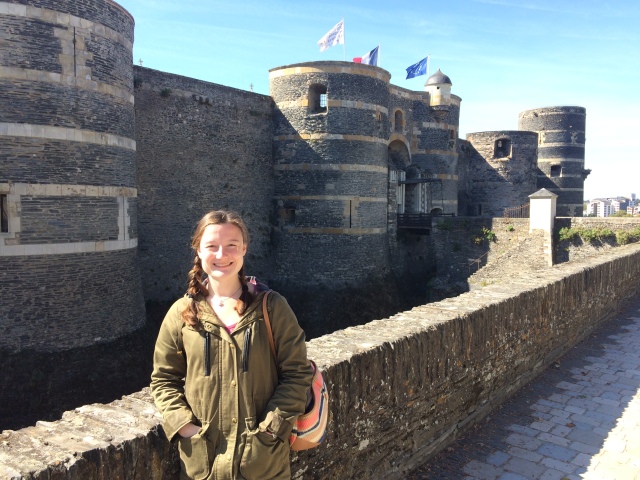
Since Angers is part of La Maine et La Loire, it makes sense that it should have a castle. However, unlike other castles in the Loire Valley, Angers’ is not elegant, or refined (or at least, not in the way that one would expect from Chambord, or Chenonceau), and certainly not from the Renaissance. This is a 9th century castle, expanded in the 13th century, which gives it a thoroughly medieval look. You can walk along the ramparts, getting views of the Angers skyline, both sides of the river, and the castle gardens. It also houses the world’s largest medieval tapestry collection, which includes the “Apocalypse Tapestry,” depicting scenes from the Book of Revelation. Extra perk: it’s open seven days a week!
Le Petit Train Touristique
If you’ve only got limited time in Angers, this little train ride is a solid introduction to Angers, and allows you to easily see the parts of Angers on both sides of the river without doing a ton of hefty walking. It’s a 40 minute tour that runs pretty frequently, and lets you take in the scenery, while also hearing the history of the town (be sure to specify language if you need something other than French as the dialogue is projected throughout the whole car, rather than through individual headphones.) It starts and ends in the square in front of the castle, and next to the tourist office.
Go for a ride on le petit train and learn all about Angers!
Musée des Beaux Arts
The Fine Arts Gallery is located in central Angers, and has a fine collection of paintings that date from several eras. My personal favorite part of this museum is that scattered throughout, there are puzzles (mainly for children, but who says you can’t be a child at heart when you visit) of certain paintings and you can sit down and complete them! Some are quite easy but the difficult ones (the kind where the piece isn’t an actual set shape) are quite complex, but I enjoy that they’re taking art appreciation to a new, and fun, level. All the museums in Angers are open seven days a week, so you can pop in any day. They also have a nice cafe, and when it’s nice outside, a courtyard where you can enjoy their delicacies in the sun.
Hard at work on one of the puzzles available to do in the museum
Watch the Sunset from the Promenade du Bout du Monde
Right next to the castle, there is a lookout point at the end of the Promenade du Bout du Monde, or the walk to the end of the world. Although you don’t actually walk to the end of the world (that would be a pretty good claim to fame), you get a beautiful panoramic view of La Doutre, the side of Angers across La Maine. It’s especially beautiful at sunset, and is a popular place to hang out when the weather is nice.
Cathédral Saint Maurice d’Angers
Like many French cities, Angers wouldn’t be complete without a cathedral. A mix of Romanesque and Gothic architecture, the cathedral has beautiful stained glass, a grand organ, and a stone floor to accentuate the 11th and 16th century designs. It isn’t as ornate as other French cathedrals, but that doesn’t make it unremarkable, or unworthy of a visit.
Maison d’Adam
Also known as the “LaMaison des Artisans,” this 15th century house is home to artisanal goods, made by more than 80 craftsmen from all over the Loire Valley. Here, you can find handblown glass, sculptures, woodcrafts, and many other fine handmade goods. Located right next to the Cathedral, and at the heart of historic Angers, this house is one of the oldest half-timbered houses in France. Whether you want to go inside or not, the outside is enough to marvel at, and it’s definitely worth seeing as you wander through the city.
Jardin du Mail
If you’re looking for a picturesque spot to enjoy your lunch, sit and chat, or just marvel at your time in France, le jardin du Mail is a perfect location for you. It’s a park located in centre-ville, complete with a gushing fountain, and pagoda, perfect for those glamor shots of the city. Although it may seem unimpressive, it’s a beautiful place to walk, and highlights the fact that Angers is one of the greenest (color wise) cities in France.
English Library
Something that I wasn’t expecting to find in Angers was an English library! It’s one of only two (I think) in the country, so we’re especially lucky to have it. Having it available to assistants means that for us primary assistants, we can easily check out children’s books for our youngest classes, or for supplementary material if needed. It also means that I was able to check out books for my own perusal while I was working, so I had something to take my mind off of work, and my eyes off of a screen. They also organize monthly pizza and games nights, movie nights, and other fun activities so if you’re missing hearing some English, it’s definitely worth heading over to check it out!
Musée Jean Lurçat et de la tapisserie contomporaine
Another of Angers’ museums, this one focuses on tapestries. It is housed in two buildings, one of which has a collection of various tapestries ranging from the 20th century, through to today (hence the contemporary part of the museum’s title), and other works, while the other resides in a hospital complex from the 12th century. The latter houses Jean Lurçat’s 1960s tapestry series, so along with the beautiful architecture of the building, you can also view very large, and exquisite tapestries that speak to the state of the world at the time. It’s not a large museum, so it doesn’t take too much time to see it all, but it makes a change from typical art museums. (Unlike the other museums of Angers, this one is located on the other side of the river, but only about a 20/25 minute walk from centre-ville).
Tapestries in the old hospital at the musée Jean-Lurçat
Musée David D’Angers
If sculpture is more your cup of tea than painting, the musée David D’Angers is just the place for you. Located just around the corner from the fine arts museum, this particular space is filled with sculptures from the renowned artist David D’Angers, who as the name suggests, came from Angers. The building itself is beautiful, with a glass roof that used to be the roof to an abbey, you’ll see statues, sketch works, and busts, all sculpted by David D’Angers, which makes the collection that much more impressive.
There you have it! Of course, there are more fun things to check out in Angers, but these have been some of my top things to do/see while I’ve been here. There are also neighboring cities accessible by bus that offer more to see and explore! Although Angers might not be the most “happening” city in France, I’m glad I was placed here during my TAPIF experience, and have enjoyed my time here.
Whatever you choose to do, Angers is a great place in France to visit, and well worth the trip! Even if you may not be able to fill a whole week up with activities, a day or two is more than enough to fully appreciate Angers. I highly recommend checking it out if you have the chance 🙂
Bienvenue en Normandie! Obviously, I was already partially there in Rouen, but Caen feels like you’re in true Normandie territory. I literally only had one day to explore as the day I left was a Sunday (and Easter Sunday to boot) so as we know by now, nothing was open. I had a jam packed Saturday, and here’s how it went down:
I woke up early to catch a train to Bayeux, which is only 15 minutes away from Caen, so very easily accessible. I walked straight to the Bayeux Tapestry museum, which houses the iconic tapestry for which the museum is named. There’s an audio guide that narrates each scene in the tapestry, and helps you navigate your way through the story. I found it very helpful, and a fun way to ensure that everyone can truly enjoy the tapestry. It’s very impressive to see it in person, and even more so when you think about everything it survived in order to still be here today (I mean, it was made 1000 years ago, and has survived through two world wars). There’s also an exhibit which discusses more about the tapestry’s history, along with the techniques used to create it, and the history of the contents within the tapestry. I wasn’t as excited by the exhibit (I personally think it should be before the viewing of the tapestry), but I was also rushing a bit to ensure that I got to the museum of the battle of Normandy before it closed for lunch (yes, you read that right, the museums close for two hours at lunch time). Even with my rushing, I still spent over an hour there, although the audio guide itself is 25 minutes.
There are three museums within the Bayeux Museum “complex,” but I only opted to visit two (if you know you want to visit more than one, you can buy a slightly reduced rate that contains entrance to more than one museum). The other museum I visited was the Musee de la bataille de Normandie, which is, as the title suggests, a museum dedicated to the Normandie beach landings, and everything that occurred afterwards in order to liberate Caen (and the rest of France). It’s certainly extensive, and it highlights every single beach landing that took place in early June (this year is the 75th anniversary of those same beach landings, as it happens). What I found most fascinating was the information about the two months that followed those landings. I feel like a lot of us learn about the beach landings and then the end of the war (without much in between relating to Normandie), but I was glad to learn of everything that truly went into liberating Caen, and then ultimately Paris. They have artefacts, and relics from those who served in WWII, along with providing great context for how important Normandie was in the outcome of the war. If you’re interested in any aspect of WWII, this is definitely a place to visit.
After the museums, I took a brief walk around the Cathedral. Remarkably, Bayeux was relatively unscathed following the war (the tapestry survived for one), so many of the structures are still original. I should’ve kept a list of all the cathedrals I’ve visited in this country because the number is probably quite large at this point.
Bayeux Cathedral
After all that sightseeing, I had a lovely tartiflette for lunch before hopping on the quick train back to Caen. Seeing as it was now after lunch, my time was limited so I set straight to visiting what I wanted to see. I walked from the train station to the chateau de Caen, which is a middle aged castle that sits atop a small incline, overlooking the city. Entrance to the ramparts is free, so you’re able to wander around as much as you like, and adore the views onto the city. It’s a large expanse, and with a lot of greenery, so it seems to be a place to picnic or hang out when the sun is shining (which again, it was doing quite beautifully while I was there). It was fun to climb up and look out at Caen, and as in many French cities, I love seeing the difference between modern rooftops, and the spires of older churches/cathedrals that poke out periodically.
Seeing ancient architecture amongst modern is always fascinating to me
Inside the ramparts, however, are two museums (for which there is a fee associated, but if you’re under 26, like yours truly, then it’s free!) There’s the musée de Normandie, which is a history museum of Normandie. The beginning of the museum is similar to many in that there’s a Neolithic age, Stone Age, and all that Jazz. It gets more interesting when the Vikings come into the picture, and then more so when they discuss what makes this region unique from others in France. There was also an “images of Caen” exhibit in the ramparts associated with the museum, which had paintings, photographs, and other images of the city throughout time, which was interesting to see how it has evolved! There was even a painting with one of the Louis’ (don’t ask me which one, I don’t remember, and there are too many of them) receiving the keys to the city!
The other museum is the fine arts museum, which offers two floors of paintings that span several centuries. I hadn’t originally planned on visiting it, but the combination of a free ticket, plus the Gilets Jaunes convening outside (it was a Saturday, typical), meant that I went inside to have a peek around. I wouldn’t say it’s a must-see, but I’m also not the biggest fine arts museum person (I have a limit, and I’ve done a lot this trip).
I certainly didn’t see everything in Caen, or even skim the surface of Normandie, but I’m glad I added it to my list of cities to visit. I can’t believe how quickly my two weeks went by, but just like that, my mini Tour de France is complete, and I can now check off so many beautiful cities from my ever growing list of places to visit.
I’m up North now, in Normandie! It took a while to get here from Southern Bordeaux (three trains, and four hours to be exact), but that didn’t diminish my enthusiasm for exploring. Having only one full day here, I wanted to see a lot, and it is possible to hit most (if not all) of the big things here in one day, although of course, you can space it out over two so as not to feel like a race against the clock the whole time.
I started my morning off by walking through the Vieux Marché. If you come back later in the day, there can be a market of fish and meat set up. There are also brasseries and bars surrounding the square, as well as a modern church dedicated to Joan of Arc (more on why she’s so renowned in this area in a bit). Here, you can also see a vast array of the half timbered houses which litter the city. Rouen definitely felt like one of the older cities I visited on this trip, and these houses are partially the reason for that feeling.
Half timbered houses blend in with modern architecture
Just a few minutes walk away is the Cathedral Notre Dame de Rouen. Much like the cathedral baring the same name in Paris, the facade of the one in Rouen is equally ornate. There’s a spire, and several detailed carvings anywhere you want to look. The inside is vast and large, although to me, it was not nearly as impressive as the exterior. I don’t know how often the bells ring, but I had dinner in the square in front of the cathedral, and listened to the bells for a solid 7/8 minutes, and I would highly recommend it as an experience in Rouen.
Cathedral Notre Dame de Rouen
Just around the corner, you can find the Historial Jeanne d’Arc, a modern museum dedicated to the retrial for Joan of Arc following her death. Joan of Arc was put on trial, and ultimately burnt alive in Rouen, hence her importance in the city. This museum focuses on the retrial that ultimately “exonerated” her, and proved that her first trial had been heavily biased. The museum has five rooms through which you walk, and then sit to watch a video presentation in each one, as you follow the retrial chronologically. The videos are very well done, and it’s a creative way to tell the history. It’s difficult to explain, so I’ll leave it at the fact that you have to see it to understand what I mean. They also have an audio guide that translates the videos as you watch them!
Since at this point it was lunch time, and some attractions take a lunch break as well, I decided to walk by the palais de justice. This building has elements from the 14th century, and although I didn’t go in (I’m not even sure you can), the exterior is definitely something to be seen. You can tell it’s from a similar period to the rest of the old part of town, and it made me wonder what the inside must look like! This was definitely a quick stop of mine, but if you appreciate old architecture, it’s worth a stop.
The architecture can transport you back in time (if it weren’t for the modern car sitting out front)
Following along the old history trail of Rouen, I next visited the Gros Horloge, or the big clock. It’s hard to miss it, and it definitely lives up to its name. The clock offers admittance to climb up the belfry, as well as to see the inner workings of the clock itself, all while listening to an audio guide that explains how it all works, and what the significance of this clock was. There are “some 100 steps,” but when you reach the top, there’s a panoramic view of the city. It’s important to note that this attraction closes from 12-2, so you have to visit it either before or after lunch (I opted for after), and that only 30 people are allowed up at a time, so the earlier you get there, the more likely you won’t have to wait to start climbing!
Gros Horloge and Belfry Tower
View of the cathedral from the top of the Gros Horloge
After climbing all those steps, I decided that it would be a good idea to walk almost 2 miles to the jardin des plantes, way on the other side of the Seine. The old city of Rouen is fairly concentrated in one area, so of course, this one attraction had to be super far out… it seems to me that a lot of cities have these kinds of gardens, but this one in particular is massive (I know, it feels like I say this about every garden I visit). You could easily spend several hours here, or even potentially get lost! There’s a play area for kids, green houses, pétanque and basketball courts, grassy areas, and so much more. I feel like I barely scratched the surface and I wandered around for almost an hour! It’s obviously a place to go when the sun is out, and it was a lovely 74 (or 24 for the Celsius speaking world), complete with shining sun, and accompanying minor sunburn.
To save time (and myself from getting too sweaty), I took the “metro” back into the old part of town. I use quotation marks because it does go underground, but it’s more a tram that does so, rather than a full on underground metro service. In fact, when it does go underground, it really isn’t that far down, but it’s still a good form of transport! Most of the stops seem to be on the opposite side of the Seine from where all the historical things are, but I would highly recommend it for getting to and from the jardin des plantes, especially if you’re pressed for time or the sun is too hot!
If you still have more time in your day after that jam packed schedule, you can also visit the tour de Jeanne d’Arc, the tower where Joan of Arc was held prisoner and faced trial. You can also ask the tourism office for a Joan of Arc passport to follow more of her “steps” as you discover Rouen.
There’s also the Fine Arts museum, along with seven other Rouen museums whose permanent collections are now free to the public, so if you’re stumped for things to do, there’s no shortage of museums! I only visited the Fine Arts one but let me tell you, it is FULL of paintings, and labyrinth like so trust me when I say it feels like it’s never ending. It almost becomes a game to find your way out! That being said, there are a lot of beautiful paintings and sculptures, and something for truly every taste.
• Day trip to Le Havre •
Since I had the better part of a day before my 6pm train to Caen, I decided to take a short half day trip to Le Havre. Trains are pretty frequent and the ones I took clocked in at a little under an hour each way. Le Havre, like many cities in Normandie, had to rebuild after WWII, and chose to rebuild in a modern way. As such, this is reflected in the architecture, and even though there is still a remaining old quarter, much of the city feels new and modern.
Since I was only there for four hours, I did what was easily accessible by foot from the train station. As such, I visited the musée de l’armateur, which is an art museum in an old house where merchants resided, and which was used as a trading office. It’s on five floors, and you’re given a 100 page booklet filled with information regarding every piece in the museum. There’s a lot, but it’s an interesting visit.
I also visited two churches while there. The cathedral, which survived WWII, and is one of the oldest buildings in Le Havre, and l’église de St. Joseph, which is shaped like a lighthouse. The inside of the former is currently being renovated, while the latter is filled with stained glass all the way up to the top.
Eglise de St. Joseph – that definitely looks like a lighthouse, right?
There’s also a large shopping center located near the docks. It’s just across from the train station, and offers a view of a marina, and the large harbor. The sun was shining while I was out, so it made everything that much more beautiful. I had wanted to do the jardin suspendus but unfortunately they were a little too far out for me to hit and still make my train. Even with that though, it was still a great four hours, and I’m glad I ventured beyond Rouen.




 Not Your Average Giraffe