Moving along through France, I couldn’t avoid wine country, and that leads us straight to Bordeaux (I should say whether you’re a fan of wine or not, this is still an interesting place to visit). It took me 2.5 hours via train from Toulouse, but it definitely didn’t feel that long. The center of town is a bit away from the train station, so my hostel was a half hour walk away. Once I got in, I headed out to dinner, and it quickly started pouring! I seem to have bad luck with the skies opening up on this trip!
My only full day in Bordeaux was a beautiful one, with the sun shining, and temperatures high enough to go out without a scarf (gasp, I know, but the French are still wearing one anyway, go figure). I started out the morning with a visit to the Cathedral, which seemed somewhat more poignant following the fire at Notre Dame the night before. I found the architecture outside to be of more interest to me than what was inside but that being said, the stained glass windows always catch my eye.
Bordeaux is a fairly easily walkable town, so I next walked to la grosse cloche, which is a big bell, although it also has a big clock on its side as well. The time is accurate although the date read in June, so not 100% perfect, but it’s still a fun thing to see randomly as you walk through town.
La Grosse Cloche
As you walk along, there’s also a Basilica, although I only saw the outside of it so I can’t fully attest to its “cool” factor. However, the exterior is beautiful, although not as striking as the basilicas in Lyon or Marseille that I’ve seen so far on this trip.
I also took some time to learn about Aquitaine’s history at the Musée d’Aquitaine. It was a seemingly never ending museum that touched on the history of the region from prehistory all the way to the 21st century. It was definitely impressive to see so many artifacts and relics of history, as well as to see how old this area of France truly is! At one point, I did stop reading the information cards and just started looking because it got to be a bit too much… (additionally, the English translations stop once you enter the Middle Ages, and don’t start back up for a while, which could’ve contributed to my lack of willingness to read as well).
Since the weather was so lovely, I had a picnic on the esplanade des Quinconces, or at least, on the Quai beneath it and overlooked the water as I basked in the sunlight (you can also partake in the very French hobby of people watching). As I was so near, I went over to the jardin public, which is a large expanse of park (a lovely escape from the bustling city life), and even contains a botanic garden! I believe the fine arts museum is also housed in the garden, so there are a multitude of things you can visit there! I love the big parks that exist in big cities here, and the fact that so many people visit and spend time in them.
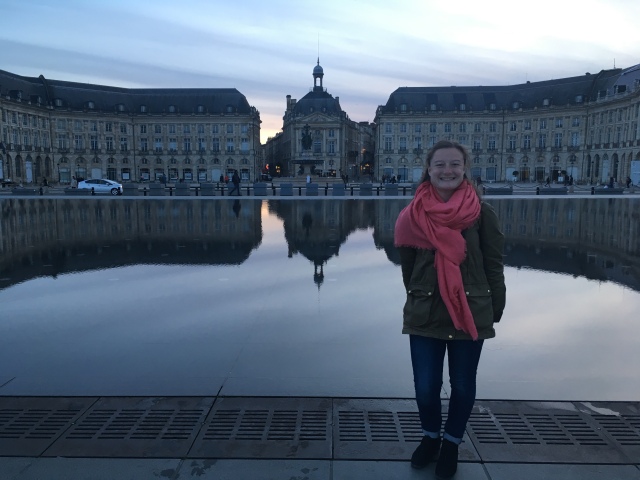
The thing that kind of made the biggest impression on me in Bordeaux was this thing called the miroir d’eau. It’s a large water pond that serves as a reflecting pool for the buildings surrounding it (although I should say it empties and fills with water so sometimes it’s just a reflective surface). It’s both a play thing for people young and old (who doesn’t get a kick out of splashing through not even ankle deep water), and something beautiful to admire. It’s worth seeing it during the day and at night to truly get the full effect. When the lights on the buildings turn on after sunset, it’s really a sight to see, and makes for some stunning photographs. Many people gather for the photo opportunity, and just for the pretty sight.
Miroir d’Eau by dayMiroir d’Eau by night
Seeing as this is wine country, I would’ve been remiss to not at least taste a small sample. There are two museums for wine: cité du vin (which is very modern, and apparently takes a lot of time to explore), and the museum of trade and wine. I opted for the latter, both due to its smaller price (only €5 at a reduced rate!), and it seemed less intense. For the entry fee, you get to explore some wine caves that discuss the history of the wine industry in Bordeaux, which is quite extensive! It was super interesting to learn about the way wine used to be bottled, how it was traded, and its significance to the area. Moreover, the museum itself is situated in an old wine merchant’s house, so you’re actually stepping through history. After your self guided tour through the two caves, you’re treated to a wine tasting. Having got there earlier in the day, I got essentially a private information session about wine in Bordeaux, and I learned a decent amount. For instance, did you know that the wines are named after grapes (i.e. Cabernet Sauvignon, Merlot…)? Maybe you did, but I certainly didn’t! Bordeaux has six main grapes, three red and three white, as well as six wine production regions. I got to try two wines: a claret, and a red wine, as well as a chocolate covered wine dipped dried grape! I’m not the biggest red wine fan but I actually really enjoyed the claret, and I’m proud to say, drank the whole sample! I may not be a wine connaisseur, but I certainly felt sophisticated doing a wine tasting, and now I know what to look for when I’m testing out what wines best suit my palette. It was honestly a great experience and it was well worth the entry price!
Another highlight of my days in Bordeaux was the fact that I got to meet up with a fellow alumna from Scripps! I don’t mind solo travel, but it becomes that much more enjoyable when you get to do things with other people, and when you have someone to talk to throughout the day! I’m not disparaging the other cities I’ve visited, but it’s been super fun to have a travel buddy, even if only for a day and a half.
That was my Bordeaux adventures! Other interesting things to see include all the portes (doors, sometimes more like giant gates), that are around the city’s circumference, and I’m sure they once held significance regarding entering and exiting, but they’re fairly elaborate and it’s almost comical as they just stand amongst all the modern architecture. One such example is the Porte Cailhau.
I’m headed up North for the last leg of my April holidays, but so far, the cities I’m visiting have yet to disappoint me, and I’m pleased with all I’ve been able to achieve!
When I was in fifth grade, our class trip was to Toulouse, where we spent 10 days in a science camp slightly outside the city. I have nothing but fond memories of my time in Toulouse, so when deciding where to go for my mini Tour de France, I knew that I had to go back and (re)visit Toulouse. I am pleased to say that my time here 12 years later was equally as positive as it was my first time here.
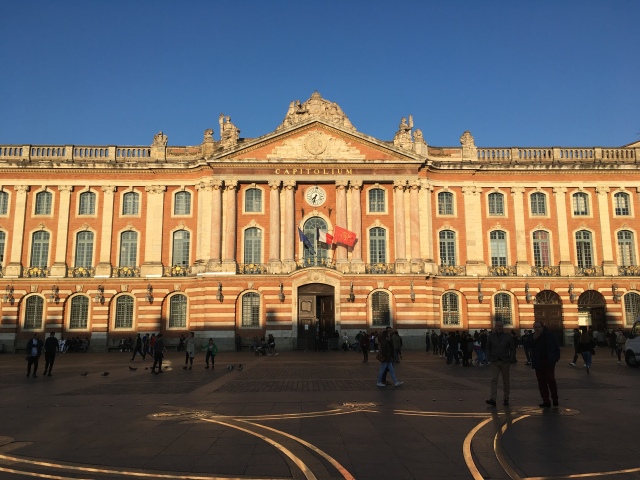
I arrived in Toulouse around 6pm following a 3.5hour train ride from Marseille. After dropping my things at my hostel, I decided to take advantage of the remaining sunlight, and do a quick wander. Since none of the sights were open, I opted to instead do some shopping at my all time favorite: Primark. Don’t worry, I didn’t spend that much, but I always have to visit one whenever I see one! I walked from there to the Pont Neuf to see the views of the Garonne River, and crossed over just because. There were many people sitting and standing along the bridge and water front in preparation for the sunset, especially now that the weather has become a little nicer. Toulouse is named la ville rose, or the pink city due to the color of the roofs, but also because of the color the sun makes as it hits the buildings. I didn’t stay around for sunset, but I did get to see that lovely pink color on the Mairie in the Place de La Capitole as I strolled back in for the night.
Place de la Capitole living up to la ville rose’s reputation
My first full day in Toulouse was a Saturday, which is also Gilets Jaunes day. I happened to be in town for “act 22”, and although I didn’t actually see any (I avoided the areas where they were meant to be), I did see the heavy police presence (I’m talking vans blocking several streets, dozens of armed police and gendarmes fully kitted out and even two, what I think were, small tanks). I don’t think I’ll ever be able to look at a high vis vest again.
ANYWAY. Even with that small disruption, I still managed to check off all the things I wanted to see, and hit 40,000 steps in one day – an all time record for me! I started my morning off by visiting La Basilique St. Sernin, which I distinctly remember from my fifth grade visit. Something about its architecture and shape lent itself to being vividly etched in my memory. I admired the inside before heading off on foot to the Jacobin’s Church and Cloister, not too far away. The building isn’t as impressive (or at least, not in the same way as the basilica) on the outside, but there is stained glass adorning every wall inside. There are also cloisters you can visit for a small fee. Since two churches weren’t enough, I decided to complete the trifecta by visiting the Cathédrale Toulouse – Paroisse St. Étienne. Like the other two, it has an ornate interior with stained glass, but I enjoy seeing how different churches look both from the exterior and the interior.
Basilique Saint Sernin
After all my church exploring, I decided to do some museum venturing. The Museum Toulouse, is located right in the jardin des plantes, and is the natural history museum. I opted to view both the permanent and temporary exhibits (although you can choose just one), since most natural history museums, at their base, contain similar information. Their temporary exhibition was on the Easter Islands, while their permanent exhibits covered everything you would expect from such a museum. At some points, I felt like I was back in my university biology courses! The museum also contains green houses, that lead out into a smaller section of the larger garden. It felt at some points like the museum never ended, and I kept discovering more rooms and more information. I enjoyed the change from my typical history museums!
After eating to refuel from my morning adventures in Place De La Daurade, I took a leisurely stroll along the Canal du Midi. Even though I remember riding a bateau mouche down the canal the last time I was here, I still wanted to “experience” the canal, and admire the twin rows of trees that adorn either side of the water. I didn’t walk the whole thing, but a decent enough portion. It’s also just a very pleasant walk along the banks.
Canal du Midi
Since Sunday is the day when many things are closed, I thought it would be fun to do a day trip to Carcassonne – somewhere I also visited 12 years ago. It takes anywhere between 45 minutes and a little over an hour depending on what speed of train you get to arrive in Carcassonne, but it’s a fast journey. Carcassonne within itself is a city, but its claim to fame is the walled cité de Carcassonne that looms above. It’s a 23 minute walk from the train station, and the last 10 minutes of that includes a view of the walled city as you walk towards it. Once inside the walls, you can explore the castle to hear about its restoration and its significance in French history. There are also two ramparts you can walk: the Middle Aged one, and the Gallo Roman one. Both offer views of the city, the Pyrenees (on a clear day) and allow you to see how this city was such a stronghold with its long length of ramparts, and imposing structure. Outside the castle area, there’s a church, and several eateries you can visit after exploring the ramparts. From the time my train pulled in to the time it left, I was there for six hours, and that was ample time. If you’re in the Toulouse area, Carcassonne is definitely a must do day trip!
(Unrelated but one of the memories that has stuck with me the most from my class trip is ironically from the bus drive back from Carcassonne. I distinctly remember Bad Day by Daniel Powter coming on the radio and every single one of us belting along with it to the point that the bus driver turned it up… I don’t know why that’s so singed in my memory but it is)
Walking along the rampartsEntrance to Carcassonne
My last day in Toulouse was a Monday, which although it isn’t as empty and quiet as Sunday, there still isn’t everything to do (museums are closed for instance). I visited the Japanese Gardens, which is a small part of a larger garden, and includes a pagoda, rock garden, and iconic red bridge. It felt very similar to gardens I’ve visited in the US, but it’s quite interesting to find one nestled in a large city, and as part of a bigger, unrelated park. I also checked out the larger jardin des plantes, located by the natural history museum. When reading online, I saw there was a sculpture garden (and maybe there is but I wasn’t looking in the right place), but all I found were a few sculptures scattered around the garden. They’re still nice to look at, don’t get me wrong, but it wasn’t quite what I expected. That being said, it is a very large expanse of greenery, and it makes for a nice walk around, or picnic spot if the weather is nice enough!
Another fun thing to do is go in the Capitole. It’s open on weekdays, and the interior is very ornate. Filled with gold plated tiling, and giant paintings adorning every wall, it’s almost a mini museum! The paintings are well worth a peek if you have the time, and entrance is free!
Inside La Capitole, in the courtyard
La Ville Rose was simultaneously as I remembered it, but also a new place to explore. Coming back with fresh (and admittedly older) eyes gave me a different appreciation for Toulouse, and yet, having those fond memories from so many years ago makes it feel that much more (dare I say) special than some of the other cities I’ve visited. Coming alone, I was obviously able to do more than when I was with a group, but seeing some of the same things I saw as a child was super cool, and I’m very glad I came back.
The next stop on my trip took me down South, or at least, to the South East corner of the country to visit Marseille! I’ve never been to this corner of the country, so it was kind of exciting to get to explore it and even though this is stereotypically thought of as the sunny coastal side of the country, I did have one night of thunder and rain, and another night of just rain, so looks can be deceiving… (of course, I brought the rain with me, just my luck)
From Lyon, it’s a quick 1h45minute train journey, through most of which I’m proud to say I slept – the train was oddly empty, not that I’m complaining! After arriving, I hopped onto the metro (I know, another city with underground transportation, the US really needs to get it together) to get to Vieux Port, where my hostel was located. There’s a decent amount to do in this city, so I’ll hit the key things I saw/did, and what I think you should too if you visit this area of France.
Vieux Port. Known in English as the Old Port, this is the old part of town, and what made Marseille such a pivotal city in the country throughout important eras in history. If you head over there early enough, you can catch the fish market, full of freshly caught fish being sold (you’ll also catch the scent, but it’s quickly breezed away by the slightly ocean air). Vieux Port also has a lot of bars, and eateries, so it’s definitely a hoppin’ place. It seems to be the central place of the city. It also leads into La Canebière, the kind of “high street” of Marseille.
Musée d’histoire de Marseille. As the title suggests, this is the museum of Marseille’s history. Priced at €6/€3 reductions (which applies to non EU students), this is a pretty extensive collection of artifacts found in Marseille from antiquity, through to its history during the world wars, and its place in the country today. There are many models of the city in different eras, as well as of houses, boats, and other historical objects. It’s located on three floors, and my only complaint would be that the ordering felt difficult to follow for me, and that there wasn’t quite enough information about the various eras, and different objects you were observing throughout the museum. It’s oddly located essentially in a mall, but it’s very easily accessible from Vieux Port. There is also an archeological site garden, although this was not open when I visited.
Notre Dame de la Garde. An imposing basilica located atop a hill, this is the perfect viewpoint over Marseille, and also features an ornately decorated interior and high ceilings. The basilica watches over the city, and is one of the defining elements of its skyline. I’m not sure if you can hike up to it, but I took the bus, where the terminus is the basilica, so it was a quick trip in both directions from Vieux Port.
View from Notre Dame de la Garde
MuCEM, and the Fort de Saint-Jean. A modern looking building overlooking the water, this museum includes several exhibits, as well as a viewing point that can be accessed for free. MuCEM stands for (when translated, hence the acronym not fitting) the Museum of European and Mediterranean civilizations, so the exhibitions speak to this theme. However, much of the space can be accessed without an entry ticket, so best to check what’s on at the moment to see if any of the exhibitions speak to you before immediately purchasing a ticket. From there, you get a sprawling view of the city, the waterfront, and the fort, which can be accessed from the museum via a bridge. Pro tip: there are free toilets on the fort side if you need them (and seeing as you have to pay for them in malls, it’s always good to know where they are!)
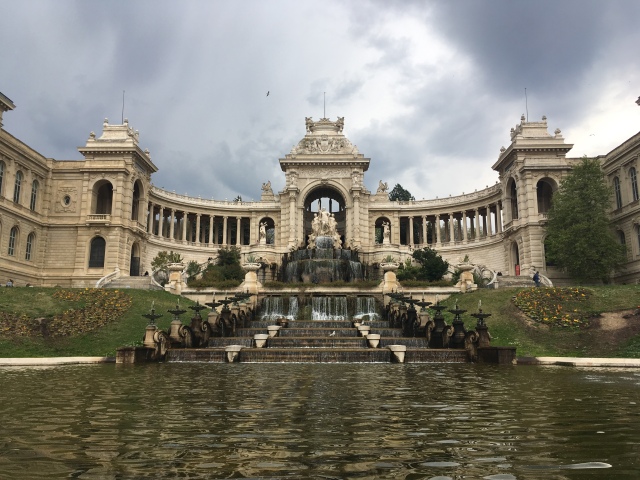
Boulevard Longchamp. Exactly as stated, it is a long boulevard, surrounded by trees on either side, leading to the Palais Longchamp, and the towering fountain there. The walk up the boulevard is worth it for the view of the fountain alone as it slowly creeps into view, but inside the palace is where the natural, and fine arts museums are housed, giving it that much more value as a sight to see. Plus, it’s a beautiful reward for having walked the whole boulevard.
Fountain at Palais Longchamp
Le Corniche. A long stretch of sidewalk that runs along the coast, this is a perfect walk (okay, more of a trek, it is over 2 miles), scooter journey, run, or bike ride that’s accompanied with fantastic views. You can start from Vieux Port and walk until you reach it, or take the bus from Vieux Port (number 83) to La Plage – the Prado Beach – and start walking from there. It was definitely a long walk, but it somehow felt leisurely (although I did get sunburnt, whoops). Along the way, you’ll walk through a neighborhood, and you can also hop down onto some smaller beaches, but the walk culminates in Plage des Catalans, about a 20 minute walk from Vieux Port. Fun fact: the full name of this walk is actually “Corniche du Président John Fitzgerald Kennedy”
Views from Le Corniche
Le Petit Train Touristique. I feel like a lot of cities have this experience, but it’s definitely a fun one. In Marseille, there are two circuits from which to choose: 1) Notre Dame de la Garde, and 2) Le Panier (the oldest part of Marseille) and Old Town. Both cost €8 each, and last anywhere from 1h15-1h45, including stops. I chose to do the first circuit, and it winds you up to Notre Dame de la Garde, and lets you get off an explore. Another train comes every 20 minutes, so you can easily come back down whenever you want. The departure point is on the Quai du Port side of Vieux Port, closer to MuCEM than the port’s square.
Food. There’s a lot of diversity in Marseille, and that extends into the cuisine. I was told to try the couscous, and I wholeheartedly agree. I tried Sur le Pouce, and not only were the portions huge and delicious, but I was seated, and served, within five minutes! I also loved this falafel sandwich I had at Au Falafel, and even though I’m a sucker for falafel, this pita was PACKED with several falafels and kind of blew my mind.
Other points of interest include Le panier, the oldest part of Marseille (and one that’s been continuously occupied I believe), Notre dame de la major, another architecturally beautiful cathedral located near MuCEM, and les terrasses du port, which is another large shopping center, but with a terrace up top with a view of the whole port. There is also Calanques, the national park, which requires more time in order to complete but is easily accessible via bus or boat from the city. I hear the views are amazing up there, but I didn’t have time to make it out there.
I ultimately ended up taking an earlier train than planned out of Marseille as I felt I had done everything I wanted to in the two days I had there, but I’m glad I’m not saying I wish I had way more time, as that’s always frustrating when traveling!
Stop two on my journey around France, and even though it was on the shorter end, that doesn’t mean that I didn’t cram it full with exploring the city. With so little time, I did really only hit the big things to see, but I still feel like I made the most of my time!
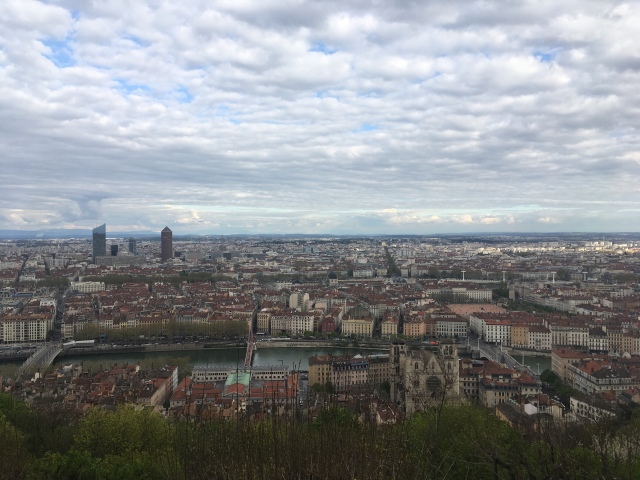
I left Strasbourg a little before 11 in the morning, and had to take three trains to get to Lyon: a commuter train (TER) to Mulhouse, a TGV to Dijon, and another TER to Lyon. It was definitely a lengthy commute, so by the time I had dropped my stuff off at my hostel, it was pushing 5:00pm. As such, I opted to take the metro (I know, I was shocked to learn Lyon has not only a bus system, but a tram system, and a metro as well! Talk about a well connected city) to Vieux Lyon. From there, I walked about 15 minutes up several steep steps and switchbacks to the Fourvière Basilica, which is situated atop a hill (somehow the small detail of its high location had been omitted from my research)… at the top, you’re greeted by a towering basilica, and a beautiful view of the city. You can enter the basilica, which has crypts, and imposing ceilings in the main area of the church. For me, the view was the highlight of this particular expedition. I decided to take the funicular down instead of walking it (call me lazy), which took considerably less time than it took me by foot.
View of Lyon from up highBasilica from river level
I ended up spending a decent amount of time admiring the view, so I merely wandered back through Vieux Lyon, and part of Presqu’île (the happening area of Lyon as the internet has told me) on the way back to my hostel. In case you’re thinking that I didn’t accomplish much, I did manage 24,000 steps with five hours spent aboard a train, so I feel like I made use of the limited daylight I had after I arrived.
Tuesday, however, was a busy (and full) day. I headed back to Vieux Lyon to check out the cathedral, and although much of it is currently under construction, it’s still impressive. There was stained glass, so automatically I was into it, but after a while, the cathedrals do tend to resemble each other a little, at least to me…
I hopped onto the metro to head over to the Parc de la tête d’Or, a giant park located in the city. There are several entrances but from any of them, you’re greeted with sprawling greenery, trees, and people sunbathing if the sun is out. If you walk far enough, you’ll end up at the zoo. Yes, you read that correctly: a Z O O. It’s free entry, and is literally just inside the park. I was shocked to say the least! The animals are in enclosures, but you can see giraffes, zebras, monkeys, and even crocodiles. It takes up a decent amount of space, and it’s cool that they’ve used it for animal preservation, although I’ll admit that Lyon is not one of the top places I would have expected to have a zoo. There’s also a lovely lake, as well as botanical gardens within the park, so you could easily spend some quality time there.
Lake in the park
I decided to treat myself to a nicer lunch (it being my birthday and all), so I went back to Presqu’île to Rue Mercier to explore the many eateries there. I decided upon The Salmon Shop, and had their delicious smoked salmon meal plan. It was well worth the visit, and I enjoyed the apple crumble that came along with my meal (insert heart eye emoji here). The plate of smoked salmon was absolutely filled, and it was more than I could eat, so I would definitely recommend eating here!
After lunch, I took the Lyon City Tram. It’s a one hour circle around the city, including an audio guided history (available in English, as well as French) along with pointing out major things to see as you drive on your way. I definitely saw things I wouldn’t have otherwise, whether because I wouldn’t have known where they were or because I wouldn’t have pegged them as something I would’ve wanted to see. The tram has a sky roof, and many windows, so no matter where you’re sat, you’ll have a great view as the city passes you by. An adult ticket costs €9, and I opted for an afternoon journey, but I will say that the timetable wasn’t the easiest to find online. I ultimately showed up at what I thought was its starting time (based on the internet) and discovered that the first run wasn’t until another 90 minutes later. That being said, I’m still glad I did it, especially as I got to then see the murals that adorn several walls in Lyon.
One of the many murals in Lyon
Ultimately, I wasn’t able to get to everything in Lyon, but I’m still pleased with myself. Had I been able to, I would’ve wanted to visit the Musee des Beaux Arts, and the Musée Gadagne, but they were both closed on Tuesday, and I didn’t have enough time Monday to get to them before they closed. Even with that though, I’d be LYON if I said that this city wasn’t a fun one to explore (get it? Like “lying”? Good. Thought it’d be fun to end on a pun this time).
For my April holidays, I decided to do a mini “Tour de France,” and as such, am hitting many big cities in France during my two weeks. My first stop was Strasbourg, and after arriving late Friday night, I had the full weekend at my disposal!
Getting from Strasbourg to Angers isn’t the easiest journey, but part of that is due to the station change in the middle. I had to take a train to Paris Montparnasse, and then descend into the metro to get to Gare de L’Est to catch the train to Strasbourg. Let me tell you, I never want to switch between those stations ever again. The SNCF website told me I’d have plenty of time in my 1h13 “layover” to change stations and yet, I only got to my train with 20 minutes to spare. I know, I know, you’re thinking that’s plenty of time, but it is a SHLEP to get from the train at Montparnasse to the metro platform, and I dread to think of doing it with more than just a small rolling suitcase (never again friends, never again).
My Saturday was chock full of walking (35,000 steps to be exact, and yes, that merits a special badge with my Fitbit), but I definitely managed to see a lot. Although long, I walked 40 minutes from my hostel to the European Parliament. I could have taken the tram, but part of me wanted to walk and see what I could of the city (there are ample trams/busses in this city, so no issues if you don’t want to walk most places). The European Parliament offers guided tours in French and German, as well as audio guided/multimedia tours in the 24 recognized EU languages (can you name them all?…because I can’t). Both of these options happen at specific times, and these change depending on whether Parliament is in session, so be sure to check online if you’re interested in visiting this government building! I arrived for the 10:30am audioguide tour, and although there are no reservations needed, it is on a “first come, first served” basis, so I wanted to ensure I was early. The tour is free, but you need to bring government ID in order to be issued a visitor’s pass to proceed with the tour.
I spent about 90 minutes there, and I thought it was really cool. Having visited the UN in Geneva, it’s super interesting to see how other parliamentary buildings function and look. We were allowed to visit the hemicycle, where parliament sits (we did the full 360 loop around), as well as an interactive area called the “parliamentarium,” which includes a selfie booth, and multimedia areas to learn about the elected members, and other fun facts about the European Parliament. Overall, I would highly recommend a visit if you’re in the area!
Standing in the observation area of the hemicycle
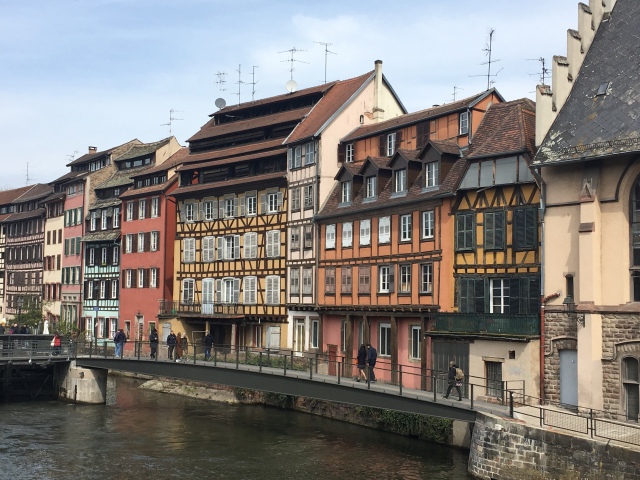
I once again took off on foot (I can’t say I did things the most efficiently) to the Petite France neighborhood of the city. Petite France is part of the historic region of Strasbourg, and has many of the architecturally iconic houses associated with Alsace, and the 12/13th centuries. You can also cross over the covered bridges, and envision what life used to be like for those living in Strasbourg centuries ago. It’s a fun little area to explore, especially when the weather is nice. Petite France is also home to the Barrage Vauban, a 17th century bridge, that also probably served as a defense system when it was built. You can climb to the top terrasse for a view of Petite France, and see it stretch into what is now modern Strasbourg.
View from the Barrage VaubanHouses in Petite France
After picking up some lunch to satisfy the energy depletion that came with all the walking, I decided to explore some of the many churches in the area. I started with the catholic Eglise St Pierre-Le-jeune, and followed it up with the Protestant Eglise St. Thomas. I ended my church expedition with the Cathedral of Strasbourg, which has a striking façade, and is immense. The inside was a little dark to me, but the outside is certainly something which should be admired. If you need to be convinced further, check out this photo and let it convince you:
I also sought out the synagogue, and I was not expecting it to be as big as it is. The outside is imposing in size, and it’s nice to know that Strasbourg is keeping in line with its religious roots. There is also the old Jewish quarter you can explore, which includes Rue des juifs, and although there’s little physical evidence of a presence left, it still did exist.
To round out my Saturday, I had a bretzel (yes, you’ve read that correctly, BBBBBBretzel. Who’s correct, you ask? If only I knew. It’s confused me and I would like to know so I can properly call them either a pretzel or bretzel).
As I happened to be in town on the first Sunday of the month, all the museums were free, so naturally I stockpiled the museums for my last day in the city. Coincidentally, it also wasn’t as nice of a day on Sunday, so it worked out for the best that I had planned to be inside most of the day.
I started out my morning at the Musée Alsacien, a museum of Alsatian history. It’s housed in an older style Alsatian house, and offers traditional costumes, furniture, housing layouts, and other various items from different eras of Strasbourg’s history. In doing so, it acknowledges the rich cultural, and religious history that exists within the region, and the way in which it has almost separated itself from the rest of France in that way (it’s still French, believe me, but you can see the outside influence, and the way it operates just a smidge differently). I really enjoyed the museum and all the artifacts, as well as its creative layout in using an actual house as the museum!
Right on the other side of the river (as in, right over a bridge), is the Musée Historique de Strasbourg: the history museum. Again, this is a super well done museum that offers a vast amount of history (sometimes even bordering on too much information) about Strasbourg from the Roman days, all the way to its place now as the European capital. It’s very informative, and I loved wandering through the ages, while discovering artifacts, clothing, and the history of the region, which is extremely vast. I imagine you could easily spend an hour or more here!
My last museum of the day was the Palais Rohan, which is a literal palace that houses three museums. Unfortunately, only two were open today (the archaeological museum being closed), but that was a decent amount to explore. I didn’t find this particular museum as interesting as the other two, but it was still a good visit. On the ground floor, there is a decorative arts museum, which focuses mainly on interior design. As you can imagine, it being a palace, there are plenty of ornate items of furniture and tapestry (when you see all the opulence, you can understand why the French revolted against the monarchy). There are also China plates, and a random room filled with different clocks. Upstairs, there’s the fine arts museum, which houses European paintings from various centuries. It’s a nice walk through, but not being an art aficionado myself, I don’t need sprawling rooms of paintings to get my art fix.
I feel like I definitely got the most out of my weekend in Strasbourg, and that I can honestly say I’ve seen what I wanted to see! I’m glad I decided to come out here as part of my mini Tour de France, and after starting out so strong, I’m even more ready for the next cities. Next stop: Lyon!
When I was in England, I wrote a blog post about Britishisms and things I’d noticed that were kind of specific to British culture. Now that I’m over in France, I thought I would do the same thing! Again, don’t get me wrong, I don’t think negatively about the French culture at all (or at least, not about everything), but I do find it fascinating to examine differences in culture, and in day-to-day life. Enjoy!
Long(er) meals
At the schools where I work, the students (and myself) get an hour and a half for lunch. This includes recess and time for eating for the kids, but in the US, it seems like you’re lucky if you get half an hour to eat. Although this means that the lunch hour can sometimes drag on if you have no one to talk to or nowhere else to go, it means that you have time to decompress and prepare yourself for the afternoon. Not to mention the fact that you don’t feel rushed to inhale your food (so I could actually prepare decent lunches for myself instead of just a small sandwich because that’s all I could eat in the time I had – although that it what I eat because who can resist a good lunch time sandwich?). The students also get much more balanced, and healthier lunches in the cafeteria, and the menus sometimes include things you’d never see in a US elementary school (one prime example would be rabbit for lunch). The best thing is that it’s not just lunches. If you go out to dinner, you’re not rushed to pay your bill after they clear your place. You can chat, hang out, and be relaxed until you’re ready to pay and leave. The French take eating very seriously.
Chip flavors
Okay, I’m not sure if this is a super “frenchism” but I got a kick out of it anyway so, I’m using it. Literally my first day in Angers, my mom and I went to Monoprix to suss out the goods, and to see what I would have access to grocery wise. We wandered around this fairly big store and somehow ended up in the chip aisle. After glancing haphazardly through the titles, my eyes fell upon a bag with a cheeseburger flavor. That was quite the double-take. From there, there was roasted chicken, pickles and mustard, and my all time favorite: ham and cranberry. I’m not sure if this is a national thing, but those are pretty daring flavors. Here I was thinking prawn cocktail in England was adventurous!
Timeliness (and its almost non-existence)
Within my time here, it has come to my attention that if you want anything done, you should’ve asked for it a week before you needed it done. Part of this is the bureaucracy, but part of it is also just a “we’ll get to it when we get to it” kind of attitude, which is nice sometimes, but not so nice when your toilet is running and you’re told it could be a week before someone looks at it (I realize this could be universal, but it’s the manner in which you’re told you’ll have to wait that really adds the oomph to this frenchism). Not to mention, you seem to need appointments for everything (for instance, for opening a bank account) and heaven forbid you be able to do something the day you planned on getting it done! One might even say they have a bit of a laissez-faire attitude towards life, and you can definitely see where that saying originated.
Stores aren’t open all the time
One of the first days I was here, my mother and I made the mistake of waiting until 3pm to try and find lunch. Much to our surprise, almost every place was closed. Many eateries close at 2pm, and don’t reopen until dinner time, around 7pm. Because of this, most places (including banks and other offices) close from 12 until 1:30/2pm to make sure that everyone can get food if they want. As aforementioned, the French take their lunch break seriously. Additionally, very little is open on Sundays. That means your options are limited for eating out, the grocery stores close earlier (if they’re even open at all), and the streets are pretty empty throughout the day. It’s fine to navigate if you’re aware of the closures, but not great if they catch you off guard. This also means that the places that ARE open on Sundays are often packed, and have long lines because of this. It can also make Sundays quite dull since there isn’t much to do. Banks are also always closed on Sunday, and many aren’t open on Monday so you better hope you don’t have any banking emergencies over the weekend (honestly not that big of a deal unless you want to do something with a person because ATMs are open 24/7). Peep this funny comic another assistant shared on Facebook to illustrate the struggle:
BREAD
I’m pretty sure the French eat bread, usually baguettes, with every meal. It’s a solid staple and I appreciate a culture that doesn’t shy away from its carbs. One fairly true stereotype of the French is the number of people who do, in fact, walk around carrying a baguette from the shops. It makes you feel slightly more French when you walk around wielding a massive loaf of bread in your arms.
Vous vs. Tu
In French, you address people differently based on their age, status, or position relative to you (formality is taken very seriously in this language). Anyone older than you, or superior to you is addressed using a “vous,” while your friends and those younger can be called “tu.” They have aptly named this se vouvoyer and se tutoyer. It’s always a question when meeting a new person whether it’s a vous or a tu situation, so to be safe, always go with the vous. Half of the teachers with whom I work have been super chill about us tutoying each other, but the others haven’t said a word, and I’m not about to rock the boat that is French grammar. Ironically, you get in trouble for not vousvoying when you should, but the teachers have also corrected me when I accidentally use vous instead of tu with them as well!
Never-ending paperwork
One thing I didn’t necessarily expect was how bureaucratic France is, and the sheer volume of copies and signatures they require for even the tiniest little thing. It feels like for any little thing, you’re going to need your birth certificate, bank information, photocopy of your passport, and your work contract, along with potentially random other tidbits. On top of that, once you’ve submitted any given application, you’ll then have to wait for approval, you’ll get a letter telling you you’ve been approved, then another letter with whatever it is you originally wanted, and then another letter outlining the details of what you’ve received. I had to sign three copies of my work contract, and when setting up a bank account, had to initial all 10ish pages of the document outlining everything. I think there are a lot of trees dying due to France’s penchant love for requiring literal mounds of paperwork for everything. Not to mention, you’re told to keep your pay stubs for the rest of your life, so honestly, I can see how it’s a bit of a thing here. To further back up the length of time things take, I received my November paystub in MARCH… you can imagine the strength of my eye roll when I opened that envelope.
Striking
Faire la grève could potentially be considered a national pastime. The French are very proud of their allotted hours for the work week, how many vacation days they get, their right to public transportation, and many other things, to the point that when one of those rights is infringed upon in the slightest fashion, the unions might announce a strike. Since moving here, there has already been a national strike (which didn’t impact me specifically but some teachers at other schools went on strike, and transportation was a little delayed), two strikes where my school(s) for the day was closed the entire day, and some smaller strikes on the bus services, which can lead to minor delays or no busses running on certain lines, and various other “social moments” that occur. (Don’t get me started on the gilets jaunes, because that’s just a whole other can of beans)
Tea with no milk
At my orientation for work, the woman in charge told us we were going to break for tea and coffee. I saw a box of English Breakfast tea, and promptly got very excited as for various reasons, I hadn’t had any tea since I arrived in France. I poured myself a nice cup (in a plastic cup), and looked around for the milk. We all searched around the room, in the fridge, and asked about it, only to be told that the French don’t take their tea with milk (cue the gasps). I thought this was just an isolated incident, but alas, I’ve seen it many more times in my schools, on essentially a daily basis! How the French can make such beautiful coffee and wine, and yet still drink tea without milk is completely beyond me.
Split classrooms
This is specific to the French education system but it isn’t a rare occurrence to have at least one (if not more) classroom that is made up of multiple grades in a school. The smaller of my two schools only has three classrooms and all three of them are split grades. The theory behind this practice is that it allows students to learn empathy and how to work with students either ahead or behind them, while also potentially pushing them to learn a little more than they would if they weren’t in a split class. Sometimes this is done, however because of size, resources, and the number of teachers available at any given school.
Scarves
I swear, in France, a scarf is the most important, and necessary accessory for any given day, regardless of the weather. In my first month in Angers, there were several low-to-high 70s days, and you’d walk around seeing people wearing heavy coats and bundled up in scarves! It’s like the scarf simultaneously keeps them warm AND keeps them from getting too hot! They also have this way of tying their scarves that I feel like unless you’re French, you can’t replicate, and I would like to be let in on that secret, please.
Non-refrigerated milk
You can still find milk in the refrigerated section, but if you go to larger supermarkets, there’s also milk you can buy on the shelves. You refrigerate it after opening, but seeing milk sitting on a shelf at room temperature threw me for a loop the first time I saw it. Plus, it expires much more quickly it seems than the ones that come straight out of the refrigerator. (Related side note: some of the yogurts have fromage blanc, i.e. white cheese written on their labels, but I have been assured that the yogurt does not, in fact, contain any cheese.)
AZERTY keyboards
It’s a minor thing, but typing with a keyboard that uses the same letters as English, but puts them in a different order is beyond confusing to my touch typing brain. Not to mention, French has accents, so those characters live with the numbers at the top of the keyboard EXCEPT they have priority over the numbers so you have to press the ALT key plus the number key in order to get the number. Don’t even get me started on punctuation as well because some keys have THREE characters so there are three different ways to achieve three different characters and honestly sometimes, I just spell the words wrong and hope for autocorrect. Sometimes I’ll even start typing incorrectly on my laptop after a day of having used a French computer… Just take a look if you don’t believe me:
MORE PAPERWORK
Did I mention the paperwork issue already? I did? Funny, because that’s exactly what the bureaucratic situation is like in France because you think you’ve done something already and know all about it, and then NOPE, you’ve got to do it all over again but this time with different information… plus signing it, submitting it by mail, along with a pdf copy submitted online, and just for kicks, you’ll have to email it along with an additional copy because vive la France. I’m already dreading leaving if only because I have to write a properly worded letter to cancel my phone plan, close my bank account, cancel my housing assistance, and terminate my rent agreement… because we love killing trees here, and making things more difficult than they need to be!
Bonjour
Even though saying hello to each other isn’t something that is specific to France, it seems like the French take a certain type of pride in uttering bonjour to their colleagues and friends (and depending on where in the region/country you are, this can be applied to crossing a random human on a walk in the park, or on the street). All the teachers with whom I work make a point of saying bonjour to me when they first see me, and I’ve frequently heard teachers say to other teachers “I haven’t said hello to you today yet, have I” as if it were sacrilege to have not greeted your coworkers in the morning. Not only this, but if they happen to have said hello to each other already, they will proceed to say rebonjour… the French have a word specifically for saying hello to one another again, and I quite enjoy the novelty of it. Not to mention, they take saying hello so seriously, that it’s essentially a routine that every interaction must begin with bonjour regardless of where, when, and with whom, and they take offense if you skip that little introduction in your interaction. I’ve frequently asked people in shops, or at the train station for assistance, and gotten their attention by saying “excuse me” and proceeding to ask my question, only to get a look of disdain in return as they aggressively look at me in order to say bonjour, to make the point that I forgot that pivotal word. (I once overheard a customer at a smaller supermarket get mad at the person behind the cash register once because he “walked in and nobody said hello” to him after he had said the requisite bonjour, so it’s a thing with strangers as well).
Nonexistent public restrooms
This seems to be a European thing in general, but France really doesn’t buy into having restrooms accessible to the general public (and if they do, they probably won’t be free). Going out, or traveling somewhere can become an endeavor of planning, and you always have to be prepared to potentially have to shell out some coins for the privilege to pee (Shout out to you if you understand the Urinetown reference there…)
La Bise
When you greet someone in a friendly setting, this can sometimes prompt the act of la bise, where you greet the other person with a kiss (it’s really a cheek-to-cheek sort of action) on each cheek (which one starts still baffles me). It’s not something that I’ve had to do frequently, but I’ve definitely had the awkward start with some people of the whole “should I, or shouldn’t I” type thing when it comes to the whole ordeal. It can certainly be disconcerting if you’re not expecting it, and perhaps a little awkward at first, but it’s definitely part of the custom. I’ve seen teenagers partake in it while greeting each other on the bus in the morning, so a sure fire way to pretend you’re wholly French, is to use la bise as a greeting (when it’s appropriate, of course)!
Lack of self checkouts
This is kind of an odd one, but in most of the supermarkets where I shop, there isn’t an option for self-checkout, meaning you have to wait in a line with everyone else (there are never enough lines), and then check out that way. This always massively stresses me out because there aren’t people helping bag the groceries (which isn’t odd within itself, necessarily), so you have to frantically bag as the cashier scans the items, but sometimes it isn’t in the right order so you end up shoving things into your bag so rapidly so that you can get out of there before the next person starts coming through. The one store where there is a quasi self check-out option calls itself “express” so I always get people giving me a slight side-eye as I rock up with my rolling basket, even though I’m quick, and I’m not actually buying that many things. I miss having the “15 items or fewer” aisles, as well as the plentiful number of checkout lanes during peak business hours.
Since Sundays can get a little boring around here (what with not much being open), I’d been wracking my brain to find a way to make myself feel productive on these days, while also occupying my time in a way that wasn’t just watching Netflix all day (although we all know that sometimes those days are desperately needed). Scrolling through my explore page on instagram, I’ve frequently seen people’s beautiful spreads in something called a bullet journal, and been intrigued by them. When I was passing through Tiger one day, I saw that they had bullet journals, and decided to take the plunge for myself. Since the journals found at Tiger aren’t too expensive, I figured if I didn’t like it, or couldn’t get the hang of it, I wouldn’t be out too much, and I would still have a nice journal for other purposes, potentially. A little under one month in, here are some of my thoughts:
Initially, I was worried that I was trying my hand at bullet journaling merely because I wanted an excuse to doodle a lot, and to make pretty planner pages. Even though that can be a big part of it, bullet journaling is at its base, whatever you want to make it. Before I actually started on a journal of my own (and had even made the purchase), it was suggested to me that I join some Facebook groups. On these pages, people ask for advice regarding purchases, or ways to layout their spreads, but they are also full of people sharing their monthly themes, or how they’ve laid out their mood trackers, so there are plenty of place from which to draw inspiration. I’ve found that these pages were a great help when I was just starting out, and have continued to give me ideas/inspiration for how I might set up future months, or future pages.
I decided to start simple. I followed the basic layout described on the bullet journal website and started with a simple index page. One of the most important bullet journaling rules is to number every page so that you can easily find everything you put in it, no matter how much you fill it up. The index is essentially just for putting all the page numbers for everything. You can also use a key to denote different symbols for all your “bullet points” that you’ll use, but I didn’t do this as I prefer just keeping a simple box, and adding a check mark in it when I’ve completed something. Again, bullet journaling is really finding what works for you, so you don’t have to follow the set up instructions verbatim. Following the index is a future log, which has the next year (or in my case, I only did six months) laid out, so you can put big events/dates in your calendar at a glance. The same goes for monthly spreads. You can make these spreads as artsy as you like, or just go with a plain calendar look to see your whole month at a glance. You’ll go more into specifics when you get into your weekly breakdowns (I’m still debating if I like these, considering that my daily events don’t change much from week to week, but I can see how this would be useful for some people). In each month, you can also have trackers. I went fairly basic doing a sleep tracker, a mood tracker, and a hydration tracker. You can personalize these to whatever you want to track (if anything), and then see how it works out.
So far (and only being a couple of weeks into it), I’m really enjoying the process of bullet journaling. I’ve set up April already – I decided to be a little bit more adventurous, and to make it themed (but again, your journal can be as artistic or minimalistic as you want), and I find that keeping a physical tracker of certain things has helped motivate me to stay on track (especially with drinking water because I’m actually abysmal at it). It allows me to have a visual representation of what I want to track, while also putting all of my to-do lists in one place, rather than on little bits of paper everywhere. Even though I’m still partial to using my phone as a reminder for big events/interviews/anything important, it’s still nice to have a physical reminder of those as well if I need to have a check-in on what my week looks like.
Bullet journaling also gives you the space for creativity in the form of bigger spreads, that can be personalized for whatever you like. For instance, I have one for countries I’ve visited in Europe, where I’ve drawn a map of Europe, and am coloring the countries as I visit each one. I also have a theatre one, where I’ve drawn the page to look like a playbill from Broadway, and am writing in each show I attend throughout the year, along with the date and location so I can have a written list of them by the end of the year. You could also pencil out some long term goals, books you’ve read in the year, or anything else that floats your boat.
I know that there’s a “certain” way bullet journaling was initially meant to be done, but it seems to have shifted into very much a personalized experience. You can use an identified “bullet journal”, or you can use any old notebook that works for you. I personally really like the little dots everywhere because it allows me to evenly space things, and connect dots fairly easily, but there are also grid lined notebooks if that’s more up your alley. I enjoy the fact that I can make it what I want, while also indulging my inner artistic side (which is not the most talented of artistic sides by any means), AND use it to stay organized. It’s a fun way to do it all, while also giving me something to do on those days where nothing else seems to peak my interest.
I think the fact that you can highly personalize your bullet journal to whatever you want it to be is something that makes this activity feasible for anyone. Sure, I may not have beautiful calligraphy adorning every page, and mine is more on the simplistic side, but it works for me. The fact that (at least, as far as I have seen), the facebook pages have been very supportive to anyone who asks for advice, makes it that much more of an inviting community. As someone who likes to scrapbook, and make those as nice as can be, and as someone who already utilizes a journal (when I can, not as great at it as I used to be), bullet journaling felt like a natural possibility of something I would like doing. It can be a bit intimidating to see all the instagram pages devoted to making beautiful pages, and youtube videos of set up processes, but I’ve been trying to just use those as inspiration, rather than something which I’m striving to achieve.
Initial thoughts: Ultimately, I’m really enjoying my initial foray into bullet journaling. I haven’t gotten to the point where I take it everywhere with me (although I do take it on holidays so I can keep my trackers up to date), but there’s something about organizing my life on physical paper that is pleasing to me. I can keep all of my to do lists in one place, and work through them strategically (as well as easily find them in my sometimes mess of a room). I’m hopeful that I’m going to keep on doing it in the months to come, and that it’ll simultaneously help me feel productive, while also giving me some joy. Here’s to hopefully more months of successful bullet journaling!
This has really just been a brain dump, and a little different from my other posts, but I figured why not explore some new topics, and talk about some new things I’ve discovered while on my travels. This has definitely been one of them! Keep your eyes peeled for future travel posts coming next month!
Even though I’ve been living in France for almost six whole months now, I feel like I haven’t really seen much of the country other than Angers, and the couple of cities I visited back in November. Angers is unfortunately not super centrally located, which can make day/weekend trips difficult, but not impossible! I opted for a weekend trip to Saint Malo, about three hours away by train. I had one connection in Laval on my way up, but the station is small so I didn’t have to run around.
Spending only a weekend somewhere means the bulk of my exploring happened on Saturday. This being France, most things don’t open until 10am anyway, so I could have a quasi leisurely morning. I decided to start the day with a trip to the aquarium, which was about a 20 minute bus ride from where I was staying, since it’s more towards the entrance to the city, rather than the center of it. I arrived for opening and spent the next 90 minutes seeing all kinds of marine life (including turtles, sharks, and everyone’s beloved friends Nemo and Dory). They’ve done a great job at laying out the exhibits, and in addition to the touch pool, they also have two “attractions” you can visit. They’re not the most thrilling, but one is an adventure underseas where you feel like you’re in a submarine at the bottom of the ocean, while the other actually allows you to go underwater in your own Nautibus as you get up close and personal with some fish on a five minute track (I’m not doing a good job at explaining the attractions, but you can google them if you’re more interested in them). I really enjoyed getting to feel like a kid again, while also seeing some new fish, as well as some baby turtles.
After the aquarium, I took the bus back to the old city, and got to explore the Intra Muros part of Saint Malo. I started with a quick stop at the beach where I touched (what I think was) the English Channel, and was able to walk up to the Fort National since the tide was out, although it wasn’t open as March is still considered off season for them.
I watched the waves crash for a bit before finally entering the walled city. I walked up along the ramparts to get a panoramic view of the city, it’s surrounding area, and the coastline. Other than the fact that it was super windy, I very much enjoyed the views, and I can say that Saint Malo is a beautiful city, indeed. I got more views as I climbed the watchtowers in the history museum.
My entry ticket also included the Solidor Tower, so I took the half an hour walk there, but unfortunately, due to weather conditions, the viewpoint wasn’t open. To their credit, it was extremely windy – to the point where sometimes I couldn’t even walk straight! I did get to, however, see their smallish museum dedicated to Breton sailors who explored Cape Horn. The wind did put a slight damper on the whole day as I definitely got wind burnt, and felt tired earlier than I normally would. I found some shelter from the wind by visiting the cathedral, which has some of the most beautiful stained glass I’ve ever seen (always a sucker for stained glass). It oddly isn’t super religious, which made it more relatable for me, at least.
To finish off my day, I had a Nutella beignet from Maison Hector, and it was divine. I made a mess for sure, but it was well worth it. I’m not sure what the deal with beignets here is, but there were many places from which they were available, so I figured I had good reason to partake (as if you ever need a reason to get something filled with Nutella).
This being France, very little is open on Sunday, so I had a day of a lot of wandering (I think I covered most of the streets in Intra Muros). I wanted to do a bus tour but I couldn’t find it (not sure if I was in the wrong place or what), so I ended up going into little stores to escape the wind, while also walking almost everywhere I possibly could. I went down to a new beach, grabbed a seashell as a souvenir, and enjoyed a galette for lunch. I made sure to grab a Kouign Amann before I left, seeing as those are a speciality of the region. I definitely had time to spare when I arrived at the train station, and had a painless journey back to Angers. Even though I only had a short time in Saint Malo, I’m glad I was able to visit, and check off a new city in France!
Ever since I studied abroad in London my junior year of university, I feel like part of me is always longing to go back to London. As soon as the pilot announced that we were beginning our descent, I could feel a smile forming on my face as I looked out onto the landscape. We touched down, and I went as quickly as I could through customs, getting my bags, and heading down to the tube. It’s super convenient to be able to hop on the Picadilly line from Heathrow and go really anywhere in London without much effort. It’s always interesting to me how easily I slip back into the ways of the tube, and how at ease I feel navigating my way around the city. It’s also nice because having been there before, I feel less stressed about seeing everything, and more relaxed with my time there.
Even though I’ve spent an extensive amount of time in London, I still enjoy wandering around, and doing a lot of walking. Some of my favorite sights to explore are Southbank, where you can walk along the Thames, by the eye, the Tate Modern, the Globe Theatre, the National Theatre, as well as see some great views of Tower Bridge, Big Ben, and Parliament. Walking along those familiar paths is so calming, and you can also walk across the Millennium Bridge (well known as the bridge the Death Eaters destroy in the seventh Harry Potter film) to St. Paul’s. I lucked out with the weather, so it was beyond pleasant to be out and about walking around the city the whole time I was there.
View of the London Eye and Big Ben
Some of my other favorite things to do in London include the many museums. Unlike a lot of other countries, the museums in London are all free (obviously special exhibits can cost some money, but the basic entrance doesn’t cost you anything). My personal favorites would have to be the National Gallery in Trafalgar Square, and the V&A in South Kensington (you can easily spend most of a day here since it’s such an extensive collection, and the museum seems to never end). This time, I also checked out the Tate Modern, and the Design Museum for the first time – a 10 minute walk from Earl’s Court Tube Station. Most of the exhibits here are paid entry, but there is a cool free exhibit on the top floor called “design, maker, user,” which looks at the evolution of technology, among other things. It’s pretty interesting because it looks at the methods that go into designing advertising, street signs (typography), as well as the history of things we take for granted in our daily lives like cell phones, laptops, and even smart watches. I found it a super easy exhibit to follow, and full of interactive things.
Speaking of the V&A, one of my “must-dos” the past times I’ve been back to London has been to have tea, and scones with clotted cream and jam at their cafe. Since I studied abroad, I stand by the fact that the V&A’s scones are amongst the best in London, and they’re truly a treat. Scones just aren’t the same in the US as they are in the UK, plus clotted cream isn’t exactly a household item either. Whether you put the cream on first or the jam, you have to admit that it’s a delicious combination. I was able to nab this one with a friend from university, so I got a tasty treat, and a well needed catch-up. I managed to have two scones during my week, one at the V&A, and one at Caffe Nero, which I would have to say is second on my list of best (easily accessible/affordable) scones in London. Of course, I had tea with my scone, and one of the things I truly love about London is the accessibility of tea. I was even able to buy tea at McDonald’s, which is something I don’t think I could find in the US! In case you were concerned about my tea supply in France, fear not, I returned to the other side of the channel with 160 PG Tips bags so I’m 100% covered, and definitely a very happy camper.
Tea and scones at the V&A
Ironically, the majority of my time in London was spent in a theatre. I’ll admit, that was one of the things that drew me to London when I was choosing where to study abroad, and it is one of the big things that keeps me coming back (along with how at home I feel there). I managed to see seven shows in the six days I was in London, and logistically, I couldn’t really have seen many more. I lucked out regarding the availability of shows, as well as the costs for my tickets. Using rush, and day seats, I never paid more than 25 pounds. I won’t do length reviews of them all, but I can’t write about my time in London and neglect to talk at least a little bit about the phenomenal shows, and actors I got to see while I was there.
Tuesday, 19 February, 8:00pm – SIX: The Musical. A clever 75 minute musical about the six wives of Henry VIII, told by his “ex-wives.” All six women are total queens (both literal and figuratively), the songs are jams, and the band is all female as well! It’s such a fun show, tells what they dub “her”story, and made for a great first show in London.
Wednesday, 20 February, 7:30pm – Come From Away. Another musical based in reality, about the real life stories of people diverted to Gander (as well as its inhabitants) following the closure of American airspace on, and after, 9/11. It’s a really touching and poignant story, and deals with the events in a beautiful way – plus, it is at its core, truly a happy story about humanity.
Thursday, 21 February, 3:00pm – True West. My first play in London this time around. A Sam Shepard piece, essentially carried by two actors. I got to sit second row to see Kit Harrington, and Johnny Flynn deal with the struggles of sibling rivalry, as well as witness nine toasters pop up toast at the front of the stage (I think that’ll stick with me longer than any other part of the play… whoops).
Thursday, 21 February, 7:30pm – Pinter Seven. The Harold Pinter Theatre put on a five month “Pinter at the Pinter” festival, where seven Pinter plays were performed over the course of the festival. I caught the sixth, and seventh Pinter play. If you’re familiar with Pinter, I saw a slight ache, and the dumbwaiter. This was my first experience with Pinter, and although I don’t know that he’s really my cup of tea, I got to see Martin Freeman and Danny Dyer act the latter play, and that was something I couldn’t have predicted would have happened to me.
Friday, 22 February, 7:30pm – Jesus hopped the ‘A’ Train. I’ve never seen a play at the Young Vic, so this show gave me an opportunity to do just that. This particular play speaks to the criminal justice system, and again, deals with a serious subject in a way that doesn’t make you feel weighed down by the content the whole time. We did “lucky dips” tickets so we were guaranteed a spot somewhere in the theatre, but we didn’t know where we’d be seated, or if we’d end up standing. I’m pleased to say my friend and I got to sit together, and we had good seats as well!
Saturday, 23 February, 2:30pm – When we have sufficiently tortured each other. This was the only play that I knew I was seeing before I left France, as one of my friends had secured two Entry Pass tickets, and invited me to come along. We got to sit front row in the Dorfman at the National to see Cate Blanchett, and Stephen Dilane. This wasn’t my favorite play that I saw, but that doesn’t mean I didn’t enjoy it – plus, it isn’t a play that I would probably have booked had I not already secured tickets. However, Cate Blanchett is phenomenal, and it was worth the price of admission just to be able to see her perform live.
Saturday, 23 February, 7:30pm – Company. I day seated this performance (ironically at the same theatre where I day sat The Ferryman last year), and got great seats in the dress circle. Company is a musical with little plot (in the sense that it’s mostly vignettes, and there’s no evident order of the scenes), but it’s a Sondheim musical, so it does have some well known songs. Not to mention, I got to see Patti Lupone perform “ladies who lunch,” as well as just see her onstage, and my younger novice musical theatre aficionado would not have imagined that happening. Also, this production did some gender bending, so Bobbie was played by a woman (which makes the whole “you’re turning 35, you should settle down” trope a little more REAL), and Amy became Jamie, but he smashed “not getting married” out of the park (also probably my favorite number as it was done hilariously). It was definitely a good final show for me.
I could go on forever about how great my week in London was, but I feel happy with what I was able to see and do while I was there. I met up with friends I hadn’t seen in almost two years, and got to have Choccywoccydoodah as well. If you’re a chocolate fan, this is a must for you. I also did some damage at Primark (of course) buying London, Paddington, and Harry Potter themed clothing and goods… I highly recommend stopping by their Oxford Street store if you want some well priced souvenirs, or themed clothing. I frequently think about London, but I don’t think I actively realized how much I missed it until I was seeing the familiar sights, hearing the voice on the tube announcing the next stop, or dining at the ever present Pret. I’m so glad I got to go back to my favorite city, and I’m already waiting for the next visit.
You can check out a little vlog of my adventures here!
So early into 2019, and I’m already checking a new country off the list! We flew into Malta on a direct flight from Charles de Gaulle, and immediately I was struck by the fact that we were on an island, completely surrounded by water, with palm trees all around the airport (which might seem silly but even with knowing I was going to an island, the landscape was just so different from where we’d been before). We spent five days exploring the island, and really, there is so much to explore! Malta is full of history (much of which I didn’t know before coming here), and is self-described as an “open air history museum,” so there’s ample to see, no matter how long you’re here.
Day One
Our first day wasn’t a full day, as we arrived a little after 13:20 on a direct flight from Charles de Gaulle in Paris. We took a shuttle to our hotel (these can be reserved at the airport, ours was €5 per person), and then walked around the area surrounding our hotel. We stayed in St. George’s Bay, which borders on the city of Saint Julian. Many cities make up Malta, but barring the walled ones, they tend to run seamlessly into one another. Saint Julian’s is the nightlife area apparently, so there are bars and restaurants and a casino. The evening was filled with a traditional Maltese buffet and a magic show at the “chamber of mysteries,” which gave us a good introduction to the cuisine, and culture of Malta as well as gave us a fun evening to start our time here!
Day Two
This day was spent exploring Valletta, the capital of Malta. We pre-booked a three hour walking tour, which gave us a brief overview of the city (we walked around most of it), and some detailed history as well. It was a great way to see Valletta, as well as learn some new things. On our tour, we also learned that several films and TV shows (notably Game of Thrones) have used Malta to film. Once it’s pointed out, it’s clear that the island’s architecture can stand in for many places in the world: as Malta, anywhere in Italy, parts of the Middle East, and even Northern Africa. It’s versatility is impressive and every view point is phenomenal.
Valletta is an easily walkable city, where it’s difficult to really get lost. Some of the highlights include St. John’s Co-Cathedral (which houses two paintings by Caravaggio), and the Upper Barrakka Gardens for a beautiful view of the three cities. Additionally, there’s the saluting battery which fires a cannon twice daily, at 12pm, and 4pm (you can watch for free from the gardens, or pay €3 and get close to the action)! There are remnants of British rule throughout the city (and the island) with red telephone booths and post boxes littering the streets as a reminder of Malta’s relatively new independence.
View of the Three Cities from the Upper Barrakka Gardens in Valletta
Day Three
From Saint Julian’s, if you want to get anywhere, you’ll probably have to go through Valletta. Once there, you can connect to many busses to get almost anywhere on the island. Today’s adventure was heading out to Rabat to visit Saint Paul’s Catacombs. There are 20 some catacombs of Christian, Pagan, and Jewish religions, complete with pavilions with descriptions and information regarding rituals, archeology, and conservation of the ruins. From Rabat, we walked into the “silent”, ancient of Mdina. Much like Valletta, it’s easy to see the history in this city, and it feels like it’s own little world due to the high walls. You can peer over the walls to see a view of that side of the island, and see why this city was once the capital of Malta.
Day Four
After having looked at the Three Cities from Valletta, we thought it might be cool to do the reverse, and look at Valletta from the cities! Once again, our first bus arrived in Valletta, before we caught the number 2 bus to Birgu. Once inside the gates, we entered the city of Vittoriosa, and walked (and got lost along the way) to Fort St. Angelo, the giant fort you can see from Valletta, and which was a major stronghold for many centuries. It was bombed 69 times during WWII, which I definitely did not know, and would’nt have known without visiting the island! From the fort, you can see the other two of the three cities, along with harbors and many boats, and Valletta from one side. Although we didn’t visit them, there’s also the Malta at War Museum, and Fort Rinella in the city next door (Kalkara).
Valletta from the Fort’s battlements
Panorama of the Three Cities from Fort St. Angelo
Day Five
Last day in Malta, and we decided to explore its sister island of Gozo. There’s a ferry located at Cirkewwa, and for only €4.95 round trip, you can get to Gozo in around 25 minutes. Granted, it took us 2.5 hours to get to the terminal via bus, but we didn’t take the straightest route (make sure to really scope out your quickest route there so you don’t back track). As soon as we disembarked, we got on a city sightseeing Hop On, Hop Off bus so we could better see the whole island in our limited time. The bus has an audio guide tour, and offers great views of the island, along with history/culture regarding Gozo. We had limited time so didn’t get off at any of the stops, but you could stop off on any of the 14 stops and explore the sites, and beaches that line the coast of the island. I imagine in the summer that many of the beaches are a great place to go, but seeing as it wasn’t entirely all too warm, we bypassed laying out in the sand. Since we returned from the ferry a little after 16:00, we got stuck in rush hour (I say rush hour, but know that traffic isn’t great at most hours considering how small Malta is), but we found a more direct route to our hotel that only took an hour!
Dwejra from the bus: one of the stops
View of Gozo harbor
Ultimately, I feel like we saw a lot of Malta! Although we definitely didn’t see it all, I feel as though I have a better understanding of the history there, and can now say I’ve been there. Malta is beautiful, and I’m glad to have visited it.
Maltese Fun Facts
They drive on the left (I say this if you’re thinking of renting a car, it’s something you should know)
They have two official languages: English, and Maltese, which is a mix between Arabic and Italian
Malta has a remarkable history: no one post could do it justice, but they don’t call it the “eye of the Mediterranean for no reason”
Malta has been independent since 1964, and joined the EU in 2004 (you can use your euros here)!
They have some fantastic local dishes. There’s a puff pastry called pastizzi which is filled with cheese and almost mushy peas. You can also dine on rabbit, and different varieties of fish
If you go to a McDonald’s here, you can get a Malteser McFlurry! (You can also find some other clever Malteser goods because that pun is too good to miss)
You can watch a vlog of my February adventures here!










 Not Your Average Giraffe