Moving along through France, I couldn’t avoid wine country, and that leads us straight to Bordeaux (I should say whether you’re a fan of wine or not, this is still an interesting place to visit). It took me 2.5 hours via train from Toulouse, but it definitely didn’t feel that long. The center of town is a bit away from the train station, so my hostel was a half hour walk away. Once I got in, I headed out to dinner, and it quickly started pouring! I seem to have bad luck with the skies opening up on this trip!
My only full day in Bordeaux was a beautiful one, with the sun shining, and temperatures high enough to go out without a scarf (gasp, I know, but the French are still wearing one anyway, go figure). I started out the morning with a visit to the Cathedral, which seemed somewhat more poignant following the fire at Notre Dame the night before. I found the architecture outside to be of more interest to me than what was inside but that being said, the stained glass windows always catch my eye.
Bordeaux is a fairly easily walkable town, so I next walked to la grosse cloche, which is a big bell, although it also has a big clock on its side as well. The time is accurate although the date read in June, so not 100% perfect, but it’s still a fun thing to see randomly as you walk through town.
La Grosse Cloche
As you walk along, there’s also a Basilica, although I only saw the outside of it so I can’t fully attest to its “cool” factor. However, the exterior is beautiful, although not as striking as the basilicas in Lyon or Marseille that I’ve seen so far on this trip.
I also took some time to learn about Aquitaine’s history at the Musée d’Aquitaine. It was a seemingly never ending museum that touched on the history of the region from prehistory all the way to the 21st century. It was definitely impressive to see so many artifacts and relics of history, as well as to see how old this area of France truly is! At one point, I did stop reading the information cards and just started looking because it got to be a bit too much… (additionally, the English translations stop once you enter the Middle Ages, and don’t start back up for a while, which could’ve contributed to my lack of willingness to read as well).
Since the weather was so lovely, I had a picnic on the esplanade des Quinconces, or at least, on the Quai beneath it and overlooked the water as I basked in the sunlight (you can also partake in the very French hobby of people watching). As I was so near, I went over to the jardin public, which is a large expanse of park (a lovely escape from the bustling city life), and even contains a botanic garden! I believe the fine arts museum is also housed in the garden, so there are a multitude of things you can visit there! I love the big parks that exist in big cities here, and the fact that so many people visit and spend time in them.
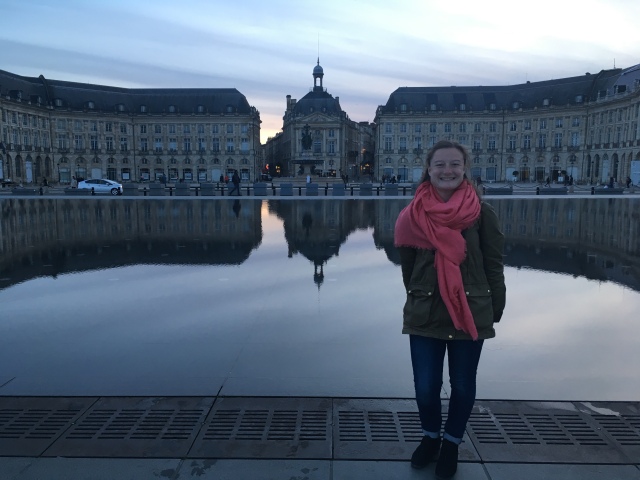
The thing that kind of made the biggest impression on me in Bordeaux was this thing called the miroir d’eau. It’s a large water pond that serves as a reflecting pool for the buildings surrounding it (although I should say it empties and fills with water so sometimes it’s just a reflective surface). It’s both a play thing for people young and old (who doesn’t get a kick out of splashing through not even ankle deep water), and something beautiful to admire. It’s worth seeing it during the day and at night to truly get the full effect. When the lights on the buildings turn on after sunset, it’s really a sight to see, and makes for some stunning photographs. Many people gather for the photo opportunity, and just for the pretty sight.
Miroir d’Eau by dayMiroir d’Eau by night
Seeing as this is wine country, I would’ve been remiss to not at least taste a small sample. There are two museums for wine: cité du vin (which is very modern, and apparently takes a lot of time to explore), and the museum of trade and wine. I opted for the latter, both due to its smaller price (only €5 at a reduced rate!), and it seemed less intense. For the entry fee, you get to explore some wine caves that discuss the history of the wine industry in Bordeaux, which is quite extensive! It was super interesting to learn about the way wine used to be bottled, how it was traded, and its significance to the area. Moreover, the museum itself is situated in an old wine merchant’s house, so you’re actually stepping through history. After your self guided tour through the two caves, you’re treated to a wine tasting. Having got there earlier in the day, I got essentially a private information session about wine in Bordeaux, and I learned a decent amount. For instance, did you know that the wines are named after grapes (i.e. Cabernet Sauvignon, Merlot…)? Maybe you did, but I certainly didn’t! Bordeaux has six main grapes, three red and three white, as well as six wine production regions. I got to try two wines: a claret, and a red wine, as well as a chocolate covered wine dipped dried grape! I’m not the biggest red wine fan but I actually really enjoyed the claret, and I’m proud to say, drank the whole sample! I may not be a wine connaisseur, but I certainly felt sophisticated doing a wine tasting, and now I know what to look for when I’m testing out what wines best suit my palette. It was honestly a great experience and it was well worth the entry price!
Another highlight of my days in Bordeaux was the fact that I got to meet up with a fellow alumna from Scripps! I don’t mind solo travel, but it becomes that much more enjoyable when you get to do things with other people, and when you have someone to talk to throughout the day! I’m not disparaging the other cities I’ve visited, but it’s been super fun to have a travel buddy, even if only for a day and a half.
That was my Bordeaux adventures! Other interesting things to see include all the portes (doors, sometimes more like giant gates), that are around the city’s circumference, and I’m sure they once held significance regarding entering and exiting, but they’re fairly elaborate and it’s almost comical as they just stand amongst all the modern architecture. One such example is the Porte Cailhau.
I’m headed up North for the last leg of my April holidays, but so far, the cities I’m visiting have yet to disappoint me, and I’m pleased with all I’ve been able to achieve!
When I was in fifth grade, our class trip was to Toulouse, where we spent 10 days in a science camp slightly outside the city. I have nothing but fond memories of my time in Toulouse, so when deciding where to go for my mini Tour de France, I knew that I had to go back and (re)visit Toulouse. I am pleased to say that my time here 12 years later was equally as positive as it was my first time here.
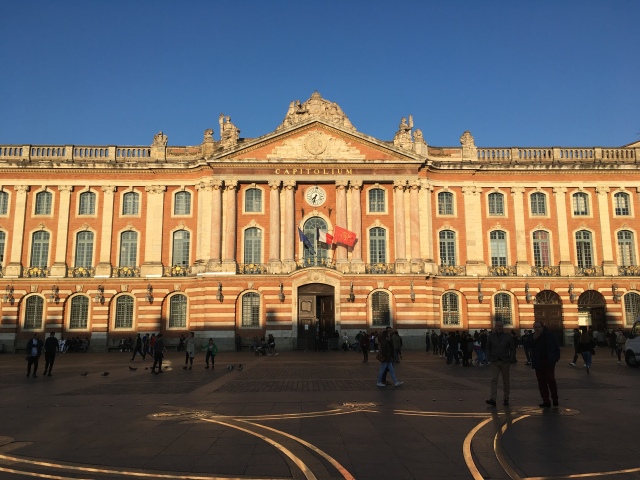
I arrived in Toulouse around 6pm following a 3.5hour train ride from Marseille. After dropping my things at my hostel, I decided to take advantage of the remaining sunlight, and do a quick wander. Since none of the sights were open, I opted to instead do some shopping at my all time favorite: Primark. Don’t worry, I didn’t spend that much, but I always have to visit one whenever I see one! I walked from there to the Pont Neuf to see the views of the Garonne River, and crossed over just because. There were many people sitting and standing along the bridge and water front in preparation for the sunset, especially now that the weather has become a little nicer. Toulouse is named la ville rose, or the pink city due to the color of the roofs, but also because of the color the sun makes as it hits the buildings. I didn’t stay around for sunset, but I did get to see that lovely pink color on the Mairie in the Place de La Capitole as I strolled back in for the night.
Place de la Capitole living up to la ville rose’s reputation
My first full day in Toulouse was a Saturday, which is also Gilets Jaunes day. I happened to be in town for “act 22”, and although I didn’t actually see any (I avoided the areas where they were meant to be), I did see the heavy police presence (I’m talking vans blocking several streets, dozens of armed police and gendarmes fully kitted out and even two, what I think were, small tanks). I don’t think I’ll ever be able to look at a high vis vest again.
ANYWAY. Even with that small disruption, I still managed to check off all the things I wanted to see, and hit 40,000 steps in one day – an all time record for me! I started my morning off by visiting La Basilique St. Sernin, which I distinctly remember from my fifth grade visit. Something about its architecture and shape lent itself to being vividly etched in my memory. I admired the inside before heading off on foot to the Jacobin’s Church and Cloister, not too far away. The building isn’t as impressive (or at least, not in the same way as the basilica) on the outside, but there is stained glass adorning every wall inside. There are also cloisters you can visit for a small fee. Since two churches weren’t enough, I decided to complete the trifecta by visiting the Cathédrale Toulouse – Paroisse St. Étienne. Like the other two, it has an ornate interior with stained glass, but I enjoy seeing how different churches look both from the exterior and the interior.
Basilique Saint Sernin
After all my church exploring, I decided to do some museum venturing. The Museum Toulouse, is located right in the jardin des plantes, and is the natural history museum. I opted to view both the permanent and temporary exhibits (although you can choose just one), since most natural history museums, at their base, contain similar information. Their temporary exhibition was on the Easter Islands, while their permanent exhibits covered everything you would expect from such a museum. At some points, I felt like I was back in my university biology courses! The museum also contains green houses, that lead out into a smaller section of the larger garden. It felt at some points like the museum never ended, and I kept discovering more rooms and more information. I enjoyed the change from my typical history museums!
After eating to refuel from my morning adventures in Place De La Daurade, I took a leisurely stroll along the Canal du Midi. Even though I remember riding a bateau mouche down the canal the last time I was here, I still wanted to “experience” the canal, and admire the twin rows of trees that adorn either side of the water. I didn’t walk the whole thing, but a decent enough portion. It’s also just a very pleasant walk along the banks.
Canal du Midi
Since Sunday is the day when many things are closed, I thought it would be fun to do a day trip to Carcassonne – somewhere I also visited 12 years ago. It takes anywhere between 45 minutes and a little over an hour depending on what speed of train you get to arrive in Carcassonne, but it’s a fast journey. Carcassonne within itself is a city, but its claim to fame is the walled cité de Carcassonne that looms above. It’s a 23 minute walk from the train station, and the last 10 minutes of that includes a view of the walled city as you walk towards it. Once inside the walls, you can explore the castle to hear about its restoration and its significance in French history. There are also two ramparts you can walk: the Middle Aged one, and the Gallo Roman one. Both offer views of the city, the Pyrenees (on a clear day) and allow you to see how this city was such a stronghold with its long length of ramparts, and imposing structure. Outside the castle area, there’s a church, and several eateries you can visit after exploring the ramparts. From the time my train pulled in to the time it left, I was there for six hours, and that was ample time. If you’re in the Toulouse area, Carcassonne is definitely a must do day trip!
(Unrelated but one of the memories that has stuck with me the most from my class trip is ironically from the bus drive back from Carcassonne. I distinctly remember Bad Day by Daniel Powter coming on the radio and every single one of us belting along with it to the point that the bus driver turned it up… I don’t know why that’s so singed in my memory but it is)
Walking along the rampartsEntrance to Carcassonne
My last day in Toulouse was a Monday, which although it isn’t as empty and quiet as Sunday, there still isn’t everything to do (museums are closed for instance). I visited the Japanese Gardens, which is a small part of a larger garden, and includes a pagoda, rock garden, and iconic red bridge. It felt very similar to gardens I’ve visited in the US, but it’s quite interesting to find one nestled in a large city, and as part of a bigger, unrelated park. I also checked out the larger jardin des plantes, located by the natural history museum. When reading online, I saw there was a sculpture garden (and maybe there is but I wasn’t looking in the right place), but all I found were a few sculptures scattered around the garden. They’re still nice to look at, don’t get me wrong, but it wasn’t quite what I expected. That being said, it is a very large expanse of greenery, and it makes for a nice walk around, or picnic spot if the weather is nice enough!
Another fun thing to do is go in the Capitole. It’s open on weekdays, and the interior is very ornate. Filled with gold plated tiling, and giant paintings adorning every wall, it’s almost a mini museum! The paintings are well worth a peek if you have the time, and entrance is free!
Inside La Capitole, in the courtyard
La Ville Rose was simultaneously as I remembered it, but also a new place to explore. Coming back with fresh (and admittedly older) eyes gave me a different appreciation for Toulouse, and yet, having those fond memories from so many years ago makes it feel that much more (dare I say) special than some of the other cities I’ve visited. Coming alone, I was obviously able to do more than when I was with a group, but seeing some of the same things I saw as a child was super cool, and I’m very glad I came back.
The next stop on my trip took me down South, or at least, to the South East corner of the country to visit Marseille! I’ve never been to this corner of the country, so it was kind of exciting to get to explore it and even though this is stereotypically thought of as the sunny coastal side of the country, I did have one night of thunder and rain, and another night of just rain, so looks can be deceiving… (of course, I brought the rain with me, just my luck)
From Lyon, it’s a quick 1h45minute train journey, through most of which I’m proud to say I slept – the train was oddly empty, not that I’m complaining! After arriving, I hopped onto the metro (I know, another city with underground transportation, the US really needs to get it together) to get to Vieux Port, where my hostel was located. There’s a decent amount to do in this city, so I’ll hit the key things I saw/did, and what I think you should too if you visit this area of France.
Vieux Port. Known in English as the Old Port, this is the old part of town, and what made Marseille such a pivotal city in the country throughout important eras in history. If you head over there early enough, you can catch the fish market, full of freshly caught fish being sold (you’ll also catch the scent, but it’s quickly breezed away by the slightly ocean air). Vieux Port also has a lot of bars, and eateries, so it’s definitely a hoppin’ place. It seems to be the central place of the city. It also leads into La Canebière, the kind of “high street” of Marseille.
Musée d’histoire de Marseille. As the title suggests, this is the museum of Marseille’s history. Priced at €6/€3 reductions (which applies to non EU students), this is a pretty extensive collection of artifacts found in Marseille from antiquity, through to its history during the world wars, and its place in the country today. There are many models of the city in different eras, as well as of houses, boats, and other historical objects. It’s located on three floors, and my only complaint would be that the ordering felt difficult to follow for me, and that there wasn’t quite enough information about the various eras, and different objects you were observing throughout the museum. It’s oddly located essentially in a mall, but it’s very easily accessible from Vieux Port. There is also an archeological site garden, although this was not open when I visited.
Notre Dame de la Garde. An imposing basilica located atop a hill, this is the perfect viewpoint over Marseille, and also features an ornately decorated interior and high ceilings. The basilica watches over the city, and is one of the defining elements of its skyline. I’m not sure if you can hike up to it, but I took the bus, where the terminus is the basilica, so it was a quick trip in both directions from Vieux Port.
View from Notre Dame de la Garde
MuCEM, and the Fort de Saint-Jean. A modern looking building overlooking the water, this museum includes several exhibits, as well as a viewing point that can be accessed for free. MuCEM stands for (when translated, hence the acronym not fitting) the Museum of European and Mediterranean civilizations, so the exhibitions speak to this theme. However, much of the space can be accessed without an entry ticket, so best to check what’s on at the moment to see if any of the exhibitions speak to you before immediately purchasing a ticket. From there, you get a sprawling view of the city, the waterfront, and the fort, which can be accessed from the museum via a bridge. Pro tip: there are free toilets on the fort side if you need them (and seeing as you have to pay for them in malls, it’s always good to know where they are!)
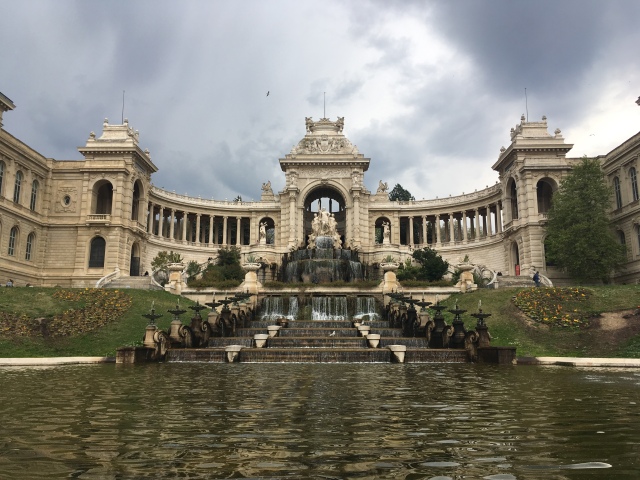
Boulevard Longchamp. Exactly as stated, it is a long boulevard, surrounded by trees on either side, leading to the Palais Longchamp, and the towering fountain there. The walk up the boulevard is worth it for the view of the fountain alone as it slowly creeps into view, but inside the palace is where the natural, and fine arts museums are housed, giving it that much more value as a sight to see. Plus, it’s a beautiful reward for having walked the whole boulevard.
Fountain at Palais Longchamp
Le Corniche. A long stretch of sidewalk that runs along the coast, this is a perfect walk (okay, more of a trek, it is over 2 miles), scooter journey, run, or bike ride that’s accompanied with fantastic views. You can start from Vieux Port and walk until you reach it, or take the bus from Vieux Port (number 83) to La Plage – the Prado Beach – and start walking from there. It was definitely a long walk, but it somehow felt leisurely (although I did get sunburnt, whoops). Along the way, you’ll walk through a neighborhood, and you can also hop down onto some smaller beaches, but the walk culminates in Plage des Catalans, about a 20 minute walk from Vieux Port. Fun fact: the full name of this walk is actually “Corniche du Président John Fitzgerald Kennedy”
Views from Le Corniche
Le Petit Train Touristique. I feel like a lot of cities have this experience, but it’s definitely a fun one. In Marseille, there are two circuits from which to choose: 1) Notre Dame de la Garde, and 2) Le Panier (the oldest part of Marseille) and Old Town. Both cost €8 each, and last anywhere from 1h15-1h45, including stops. I chose to do the first circuit, and it winds you up to Notre Dame de la Garde, and lets you get off an explore. Another train comes every 20 minutes, so you can easily come back down whenever you want. The departure point is on the Quai du Port side of Vieux Port, closer to MuCEM than the port’s square.
Food. There’s a lot of diversity in Marseille, and that extends into the cuisine. I was told to try the couscous, and I wholeheartedly agree. I tried Sur le Pouce, and not only were the portions huge and delicious, but I was seated, and served, within five minutes! I also loved this falafel sandwich I had at Au Falafel, and even though I’m a sucker for falafel, this pita was PACKED with several falafels and kind of blew my mind.
Other points of interest include Le panier, the oldest part of Marseille (and one that’s been continuously occupied I believe), Notre dame de la major, another architecturally beautiful cathedral located near MuCEM, and les terrasses du port, which is another large shopping center, but with a terrace up top with a view of the whole port. There is also Calanques, the national park, which requires more time in order to complete but is easily accessible via bus or boat from the city. I hear the views are amazing up there, but I didn’t have time to make it out there.
I ultimately ended up taking an earlier train than planned out of Marseille as I felt I had done everything I wanted to in the two days I had there, but I’m glad I’m not saying I wish I had way more time, as that’s always frustrating when traveling!
Stop two on my journey around France, and even though it was on the shorter end, that doesn’t mean that I didn’t cram it full with exploring the city. With so little time, I did really only hit the big things to see, but I still feel like I made the most of my time!
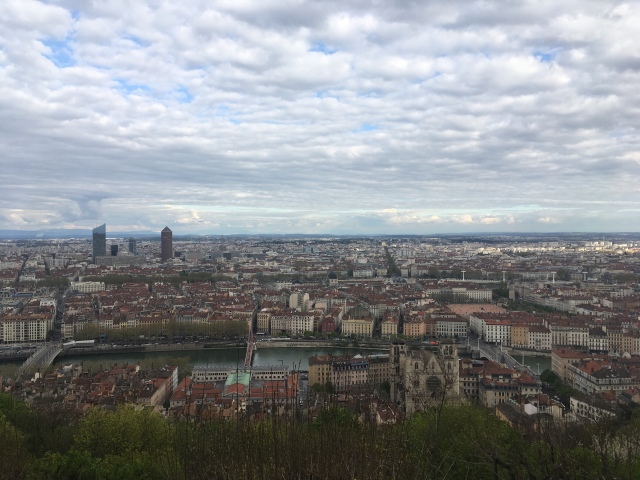
I left Strasbourg a little before 11 in the morning, and had to take three trains to get to Lyon: a commuter train (TER) to Mulhouse, a TGV to Dijon, and another TER to Lyon. It was definitely a lengthy commute, so by the time I had dropped my stuff off at my hostel, it was pushing 5:00pm. As such, I opted to take the metro (I know, I was shocked to learn Lyon has not only a bus system, but a tram system, and a metro as well! Talk about a well connected city) to Vieux Lyon. From there, I walked about 15 minutes up several steep steps and switchbacks to the Fourvière Basilica, which is situated atop a hill (somehow the small detail of its high location had been omitted from my research)… at the top, you’re greeted by a towering basilica, and a beautiful view of the city. You can enter the basilica, which has crypts, and imposing ceilings in the main area of the church. For me, the view was the highlight of this particular expedition. I decided to take the funicular down instead of walking it (call me lazy), which took considerably less time than it took me by foot.
View of Lyon from up highBasilica from river level
I ended up spending a decent amount of time admiring the view, so I merely wandered back through Vieux Lyon, and part of Presqu’île (the happening area of Lyon as the internet has told me) on the way back to my hostel. In case you’re thinking that I didn’t accomplish much, I did manage 24,000 steps with five hours spent aboard a train, so I feel like I made use of the limited daylight I had after I arrived.
Tuesday, however, was a busy (and full) day. I headed back to Vieux Lyon to check out the cathedral, and although much of it is currently under construction, it’s still impressive. There was stained glass, so automatically I was into it, but after a while, the cathedrals do tend to resemble each other a little, at least to me…
I hopped onto the metro to head over to the Parc de la tête d’Or, a giant park located in the city. There are several entrances but from any of them, you’re greeted with sprawling greenery, trees, and people sunbathing if the sun is out. If you walk far enough, you’ll end up at the zoo. Yes, you read that correctly: a Z O O. It’s free entry, and is literally just inside the park. I was shocked to say the least! The animals are in enclosures, but you can see giraffes, zebras, monkeys, and even crocodiles. It takes up a decent amount of space, and it’s cool that they’ve used it for animal preservation, although I’ll admit that Lyon is not one of the top places I would have expected to have a zoo. There’s also a lovely lake, as well as botanical gardens within the park, so you could easily spend some quality time there.
Lake in the park
I decided to treat myself to a nicer lunch (it being my birthday and all), so I went back to Presqu’île to Rue Mercier to explore the many eateries there. I decided upon The Salmon Shop, and had their delicious smoked salmon meal plan. It was well worth the visit, and I enjoyed the apple crumble that came along with my meal (insert heart eye emoji here). The plate of smoked salmon was absolutely filled, and it was more than I could eat, so I would definitely recommend eating here!
After lunch, I took the Lyon City Tram. It’s a one hour circle around the city, including an audio guided history (available in English, as well as French) along with pointing out major things to see as you drive on your way. I definitely saw things I wouldn’t have otherwise, whether because I wouldn’t have known where they were or because I wouldn’t have pegged them as something I would’ve wanted to see. The tram has a sky roof, and many windows, so no matter where you’re sat, you’ll have a great view as the city passes you by. An adult ticket costs €9, and I opted for an afternoon journey, but I will say that the timetable wasn’t the easiest to find online. I ultimately showed up at what I thought was its starting time (based on the internet) and discovered that the first run wasn’t until another 90 minutes later. That being said, I’m still glad I did it, especially as I got to then see the murals that adorn several walls in Lyon.
One of the many murals in Lyon
Ultimately, I wasn’t able to get to everything in Lyon, but I’m still pleased with myself. Had I been able to, I would’ve wanted to visit the Musee des Beaux Arts, and the Musée Gadagne, but they were both closed on Tuesday, and I didn’t have enough time Monday to get to them before they closed. Even with that though, I’d be LYON if I said that this city wasn’t a fun one to explore (get it? Like “lying”? Good. Thought it’d be fun to end on a pun this time).
For my April holidays, I decided to do a mini “Tour de France,” and as such, am hitting many big cities in France during my two weeks. My first stop was Strasbourg, and after arriving late Friday night, I had the full weekend at my disposal!
Getting from Strasbourg to Angers isn’t the easiest journey, but part of that is due to the station change in the middle. I had to take a train to Paris Montparnasse, and then descend into the metro to get to Gare de L’Est to catch the train to Strasbourg. Let me tell you, I never want to switch between those stations ever again. The SNCF website told me I’d have plenty of time in my 1h13 “layover” to change stations and yet, I only got to my train with 20 minutes to spare. I know, I know, you’re thinking that’s plenty of time, but it is a SHLEP to get from the train at Montparnasse to the metro platform, and I dread to think of doing it with more than just a small rolling suitcase (never again friends, never again).
My Saturday was chock full of walking (35,000 steps to be exact, and yes, that merits a special badge with my Fitbit), but I definitely managed to see a lot. Although long, I walked 40 minutes from my hostel to the European Parliament. I could have taken the tram, but part of me wanted to walk and see what I could of the city (there are ample trams/busses in this city, so no issues if you don’t want to walk most places). The European Parliament offers guided tours in French and German, as well as audio guided/multimedia tours in the 24 recognized EU languages (can you name them all?…because I can’t). Both of these options happen at specific times, and these change depending on whether Parliament is in session, so be sure to check online if you’re interested in visiting this government building! I arrived for the 10:30am audioguide tour, and although there are no reservations needed, it is on a “first come, first served” basis, so I wanted to ensure I was early. The tour is free, but you need to bring government ID in order to be issued a visitor’s pass to proceed with the tour.
I spent about 90 minutes there, and I thought it was really cool. Having visited the UN in Geneva, it’s super interesting to see how other parliamentary buildings function and look. We were allowed to visit the hemicycle, where parliament sits (we did the full 360 loop around), as well as an interactive area called the “parliamentarium,” which includes a selfie booth, and multimedia areas to learn about the elected members, and other fun facts about the European Parliament. Overall, I would highly recommend a visit if you’re in the area!
Standing in the observation area of the hemicycle
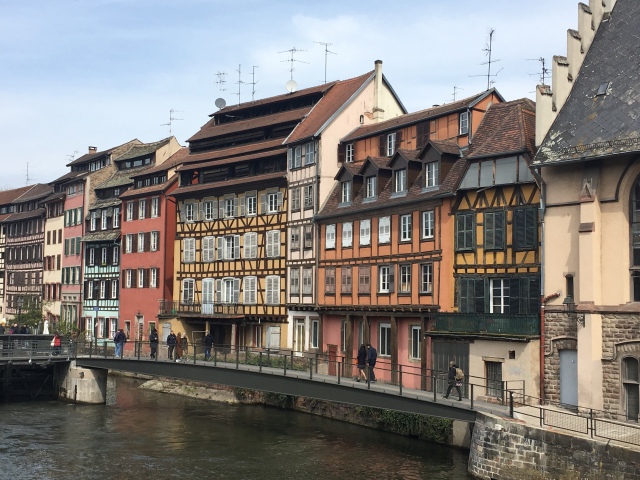
I once again took off on foot (I can’t say I did things the most efficiently) to the Petite France neighborhood of the city. Petite France is part of the historic region of Strasbourg, and has many of the architecturally iconic houses associated with Alsace, and the 12/13th centuries. You can also cross over the covered bridges, and envision what life used to be like for those living in Strasbourg centuries ago. It’s a fun little area to explore, especially when the weather is nice. Petite France is also home to the Barrage Vauban, a 17th century bridge, that also probably served as a defense system when it was built. You can climb to the top terrasse for a view of Petite France, and see it stretch into what is now modern Strasbourg.
View from the Barrage VaubanHouses in Petite France
After picking up some lunch to satisfy the energy depletion that came with all the walking, I decided to explore some of the many churches in the area. I started with the catholic Eglise St Pierre-Le-jeune, and followed it up with the Protestant Eglise St. Thomas. I ended my church expedition with the Cathedral of Strasbourg, which has a striking façade, and is immense. The inside was a little dark to me, but the outside is certainly something which should be admired. If you need to be convinced further, check out this photo and let it convince you:
I also sought out the synagogue, and I was not expecting it to be as big as it is. The outside is imposing in size, and it’s nice to know that Strasbourg is keeping in line with its religious roots. There is also the old Jewish quarter you can explore, which includes Rue des juifs, and although there’s little physical evidence of a presence left, it still did exist.
To round out my Saturday, I had a bretzel (yes, you’ve read that correctly, BBBBBBretzel. Who’s correct, you ask? If only I knew. It’s confused me and I would like to know so I can properly call them either a pretzel or bretzel).
As I happened to be in town on the first Sunday of the month, all the museums were free, so naturally I stockpiled the museums for my last day in the city. Coincidentally, it also wasn’t as nice of a day on Sunday, so it worked out for the best that I had planned to be inside most of the day.
I started out my morning at the Musée Alsacien, a museum of Alsatian history. It’s housed in an older style Alsatian house, and offers traditional costumes, furniture, housing layouts, and other various items from different eras of Strasbourg’s history. In doing so, it acknowledges the rich cultural, and religious history that exists within the region, and the way in which it has almost separated itself from the rest of France in that way (it’s still French, believe me, but you can see the outside influence, and the way it operates just a smidge differently). I really enjoyed the museum and all the artifacts, as well as its creative layout in using an actual house as the museum!
Right on the other side of the river (as in, right over a bridge), is the Musée Historique de Strasbourg: the history museum. Again, this is a super well done museum that offers a vast amount of history (sometimes even bordering on too much information) about Strasbourg from the Roman days, all the way to its place now as the European capital. It’s very informative, and I loved wandering through the ages, while discovering artifacts, clothing, and the history of the region, which is extremely vast. I imagine you could easily spend an hour or more here!
My last museum of the day was the Palais Rohan, which is a literal palace that houses three museums. Unfortunately, only two were open today (the archaeological museum being closed), but that was a decent amount to explore. I didn’t find this particular museum as interesting as the other two, but it was still a good visit. On the ground floor, there is a decorative arts museum, which focuses mainly on interior design. As you can imagine, it being a palace, there are plenty of ornate items of furniture and tapestry (when you see all the opulence, you can understand why the French revolted against the monarchy). There are also China plates, and a random room filled with different clocks. Upstairs, there’s the fine arts museum, which houses European paintings from various centuries. It’s a nice walk through, but not being an art aficionado myself, I don’t need sprawling rooms of paintings to get my art fix.
I feel like I definitely got the most out of my weekend in Strasbourg, and that I can honestly say I’ve seen what I wanted to see! I’m glad I decided to come out here as part of my mini Tour de France, and after starting out so strong, I’m even more ready for the next cities. Next stop: Lyon!
When I was in England, I wrote a blog post about Britishisms and things I’d noticed that were kind of specific to British culture. Now that I’m over in France, I thought I would do the same thing! Again, don’t get me wrong, I don’t think negatively about the French culture at all (or at least, not about everything), but I do find it fascinating to examine differences in culture, and in day-to-day life. Enjoy!
Long(er) meals
At the schools where I work, the students (and myself) get an hour and a half for lunch. This includes recess and time for eating for the kids, but in the US, it seems like you’re lucky if you get half an hour to eat. Although this means that the lunch hour can sometimes drag on if you have no one to talk to or nowhere else to go, it means that you have time to decompress and prepare yourself for the afternoon. Not to mention the fact that you don’t feel rushed to inhale your food (so I could actually prepare decent lunches for myself instead of just a small sandwich because that’s all I could eat in the time I had – although that it what I eat because who can resist a good lunch time sandwich?). The students also get much more balanced, and healthier lunches in the cafeteria, and the menus sometimes include things you’d never see in a US elementary school (one prime example would be rabbit for lunch). The best thing is that it’s not just lunches. If you go out to dinner, you’re not rushed to pay your bill after they clear your place. You can chat, hang out, and be relaxed until you’re ready to pay and leave. The French take eating very seriously.
Chip flavors
Okay, I’m not sure if this is a super “frenchism” but I got a kick out of it anyway so, I’m using it. Literally my first day in Angers, my mom and I went to Monoprix to suss out the goods, and to see what I would have access to grocery wise. We wandered around this fairly big store and somehow ended up in the chip aisle. After glancing haphazardly through the titles, my eyes fell upon a bag with a cheeseburger flavor. That was quite the double-take. From there, there was roasted chicken, pickles and mustard, and my all time favorite: ham and cranberry. I’m not sure if this is a national thing, but those are pretty daring flavors. Here I was thinking prawn cocktail in England was adventurous!
Timeliness (and its almost non-existence)
Within my time here, it has come to my attention that if you want anything done, you should’ve asked for it a week before you needed it done. Part of this is the bureaucracy, but part of it is also just a “we’ll get to it when we get to it” kind of attitude, which is nice sometimes, but not so nice when your toilet is running and you’re told it could be a week before someone looks at it (I realize this could be universal, but it’s the manner in which you’re told you’ll have to wait that really adds the oomph to this frenchism). Not to mention, you seem to need appointments for everything (for instance, for opening a bank account) and heaven forbid you be able to do something the day you planned on getting it done! One might even say they have a bit of a laissez-faire attitude towards life, and you can definitely see where that saying originated.
Stores aren’t open all the time
One of the first days I was here, my mother and I made the mistake of waiting until 3pm to try and find lunch. Much to our surprise, almost every place was closed. Many eateries close at 2pm, and don’t reopen until dinner time, around 7pm. Because of this, most places (including banks and other offices) close from 12 until 1:30/2pm to make sure that everyone can get food if they want. As aforementioned, the French take their lunch break seriously. Additionally, very little is open on Sundays. That means your options are limited for eating out, the grocery stores close earlier (if they’re even open at all), and the streets are pretty empty throughout the day. It’s fine to navigate if you’re aware of the closures, but not great if they catch you off guard. This also means that the places that ARE open on Sundays are often packed, and have long lines because of this. It can also make Sundays quite dull since there isn’t much to do. Banks are also always closed on Sunday, and many aren’t open on Monday so you better hope you don’t have any banking emergencies over the weekend (honestly not that big of a deal unless you want to do something with a person because ATMs are open 24/7). Peep this funny comic another assistant shared on Facebook to illustrate the struggle:
BREAD
I’m pretty sure the French eat bread, usually baguettes, with every meal. It’s a solid staple and I appreciate a culture that doesn’t shy away from its carbs. One fairly true stereotype of the French is the number of people who do, in fact, walk around carrying a baguette from the shops. It makes you feel slightly more French when you walk around wielding a massive loaf of bread in your arms.
Vous vs. Tu
In French, you address people differently based on their age, status, or position relative to you (formality is taken very seriously in this language). Anyone older than you, or superior to you is addressed using a “vous,” while your friends and those younger can be called “tu.” They have aptly named this se vouvoyer and se tutoyer. It’s always a question when meeting a new person whether it’s a vous or a tu situation, so to be safe, always go with the vous. Half of the teachers with whom I work have been super chill about us tutoying each other, but the others haven’t said a word, and I’m not about to rock the boat that is French grammar. Ironically, you get in trouble for not vousvoying when you should, but the teachers have also corrected me when I accidentally use vous instead of tu with them as well!
Never-ending paperwork
One thing I didn’t necessarily expect was how bureaucratic France is, and the sheer volume of copies and signatures they require for even the tiniest little thing. It feels like for any little thing, you’re going to need your birth certificate, bank information, photocopy of your passport, and your work contract, along with potentially random other tidbits. On top of that, once you’ve submitted any given application, you’ll then have to wait for approval, you’ll get a letter telling you you’ve been approved, then another letter with whatever it is you originally wanted, and then another letter outlining the details of what you’ve received. I had to sign three copies of my work contract, and when setting up a bank account, had to initial all 10ish pages of the document outlining everything. I think there are a lot of trees dying due to France’s penchant love for requiring literal mounds of paperwork for everything. Not to mention, you’re told to keep your pay stubs for the rest of your life, so honestly, I can see how it’s a bit of a thing here. To further back up the length of time things take, I received my November paystub in MARCH… you can imagine the strength of my eye roll when I opened that envelope.
Striking
Faire la grève could potentially be considered a national pastime. The French are very proud of their allotted hours for the work week, how many vacation days they get, their right to public transportation, and many other things, to the point that when one of those rights is infringed upon in the slightest fashion, the unions might announce a strike. Since moving here, there has already been a national strike (which didn’t impact me specifically but some teachers at other schools went on strike, and transportation was a little delayed), two strikes where my school(s) for the day was closed the entire day, and some smaller strikes on the bus services, which can lead to minor delays or no busses running on certain lines, and various other “social moments” that occur. (Don’t get me started on the gilets jaunes, because that’s just a whole other can of beans)
Tea with no milk
At my orientation for work, the woman in charge told us we were going to break for tea and coffee. I saw a box of English Breakfast tea, and promptly got very excited as for various reasons, I hadn’t had any tea since I arrived in France. I poured myself a nice cup (in a plastic cup), and looked around for the milk. We all searched around the room, in the fridge, and asked about it, only to be told that the French don’t take their tea with milk (cue the gasps). I thought this was just an isolated incident, but alas, I’ve seen it many more times in my schools, on essentially a daily basis! How the French can make such beautiful coffee and wine, and yet still drink tea without milk is completely beyond me.
Split classrooms
This is specific to the French education system but it isn’t a rare occurrence to have at least one (if not more) classroom that is made up of multiple grades in a school. The smaller of my two schools only has three classrooms and all three of them are split grades. The theory behind this practice is that it allows students to learn empathy and how to work with students either ahead or behind them, while also potentially pushing them to learn a little more than they would if they weren’t in a split class. Sometimes this is done, however because of size, resources, and the number of teachers available at any given school.
Scarves
I swear, in France, a scarf is the most important, and necessary accessory for any given day, regardless of the weather. In my first month in Angers, there were several low-to-high 70s days, and you’d walk around seeing people wearing heavy coats and bundled up in scarves! It’s like the scarf simultaneously keeps them warm AND keeps them from getting too hot! They also have this way of tying their scarves that I feel like unless you’re French, you can’t replicate, and I would like to be let in on that secret, please.
Non-refrigerated milk
You can still find milk in the refrigerated section, but if you go to larger supermarkets, there’s also milk you can buy on the shelves. You refrigerate it after opening, but seeing milk sitting on a shelf at room temperature threw me for a loop the first time I saw it. Plus, it expires much more quickly it seems than the ones that come straight out of the refrigerator. (Related side note: some of the yogurts have fromage blanc, i.e. white cheese written on their labels, but I have been assured that the yogurt does not, in fact, contain any cheese.)
AZERTY keyboards
It’s a minor thing, but typing with a keyboard that uses the same letters as English, but puts them in a different order is beyond confusing to my touch typing brain. Not to mention, French has accents, so those characters live with the numbers at the top of the keyboard EXCEPT they have priority over the numbers so you have to press the ALT key plus the number key in order to get the number. Don’t even get me started on punctuation as well because some keys have THREE characters so there are three different ways to achieve three different characters and honestly sometimes, I just spell the words wrong and hope for autocorrect. Sometimes I’ll even start typing incorrectly on my laptop after a day of having used a French computer… Just take a look if you don’t believe me:
MORE PAPERWORK
Did I mention the paperwork issue already? I did? Funny, because that’s exactly what the bureaucratic situation is like in France because you think you’ve done something already and know all about it, and then NOPE, you’ve got to do it all over again but this time with different information… plus signing it, submitting it by mail, along with a pdf copy submitted online, and just for kicks, you’ll have to email it along with an additional copy because vive la France. I’m already dreading leaving if only because I have to write a properly worded letter to cancel my phone plan, close my bank account, cancel my housing assistance, and terminate my rent agreement… because we love killing trees here, and making things more difficult than they need to be!
Bonjour
Even though saying hello to each other isn’t something that is specific to France, it seems like the French take a certain type of pride in uttering bonjour to their colleagues and friends (and depending on where in the region/country you are, this can be applied to crossing a random human on a walk in the park, or on the street). All the teachers with whom I work make a point of saying bonjour to me when they first see me, and I’ve frequently heard teachers say to other teachers “I haven’t said hello to you today yet, have I” as if it were sacrilege to have not greeted your coworkers in the morning. Not only this, but if they happen to have said hello to each other already, they will proceed to say rebonjour… the French have a word specifically for saying hello to one another again, and I quite enjoy the novelty of it. Not to mention, they take saying hello so seriously, that it’s essentially a routine that every interaction must begin with bonjour regardless of where, when, and with whom, and they take offense if you skip that little introduction in your interaction. I’ve frequently asked people in shops, or at the train station for assistance, and gotten their attention by saying “excuse me” and proceeding to ask my question, only to get a look of disdain in return as they aggressively look at me in order to say bonjour, to make the point that I forgot that pivotal word. (I once overheard a customer at a smaller supermarket get mad at the person behind the cash register once because he “walked in and nobody said hello” to him after he had said the requisite bonjour, so it’s a thing with strangers as well).
Nonexistent public restrooms
This seems to be a European thing in general, but France really doesn’t buy into having restrooms accessible to the general public (and if they do, they probably won’t be free). Going out, or traveling somewhere can become an endeavor of planning, and you always have to be prepared to potentially have to shell out some coins for the privilege to pee (Shout out to you if you understand the Urinetown reference there…)
La Bise
When you greet someone in a friendly setting, this can sometimes prompt the act of la bise, where you greet the other person with a kiss (it’s really a cheek-to-cheek sort of action) on each cheek (which one starts still baffles me). It’s not something that I’ve had to do frequently, but I’ve definitely had the awkward start with some people of the whole “should I, or shouldn’t I” type thing when it comes to the whole ordeal. It can certainly be disconcerting if you’re not expecting it, and perhaps a little awkward at first, but it’s definitely part of the custom. I’ve seen teenagers partake in it while greeting each other on the bus in the morning, so a sure fire way to pretend you’re wholly French, is to use la bise as a greeting (when it’s appropriate, of course)!
Lack of self checkouts
This is kind of an odd one, but in most of the supermarkets where I shop, there isn’t an option for self-checkout, meaning you have to wait in a line with everyone else (there are never enough lines), and then check out that way. This always massively stresses me out because there aren’t people helping bag the groceries (which isn’t odd within itself, necessarily), so you have to frantically bag as the cashier scans the items, but sometimes it isn’t in the right order so you end up shoving things into your bag so rapidly so that you can get out of there before the next person starts coming through. The one store where there is a quasi self check-out option calls itself “express” so I always get people giving me a slight side-eye as I rock up with my rolling basket, even though I’m quick, and I’m not actually buying that many things. I miss having the “15 items or fewer” aisles, as well as the plentiful number of checkout lanes during peak business hours.
Even though I’ve been living in France for almost six whole months now, I feel like I haven’t really seen much of the country other than Angers, and the couple of cities I visited back in November. Angers is unfortunately not super centrally located, which can make day/weekend trips difficult, but not impossible! I opted for a weekend trip to Saint Malo, about three hours away by train. I had one connection in Laval on my way up, but the station is small so I didn’t have to run around.
Spending only a weekend somewhere means the bulk of my exploring happened on Saturday. This being France, most things don’t open until 10am anyway, so I could have a quasi leisurely morning. I decided to start the day with a trip to the aquarium, which was about a 20 minute bus ride from where I was staying, since it’s more towards the entrance to the city, rather than the center of it. I arrived for opening and spent the next 90 minutes seeing all kinds of marine life (including turtles, sharks, and everyone’s beloved friends Nemo and Dory). They’ve done a great job at laying out the exhibits, and in addition to the touch pool, they also have two “attractions” you can visit. They’re not the most thrilling, but one is an adventure underseas where you feel like you’re in a submarine at the bottom of the ocean, while the other actually allows you to go underwater in your own Nautibus as you get up close and personal with some fish on a five minute track (I’m not doing a good job at explaining the attractions, but you can google them if you’re more interested in them). I really enjoyed getting to feel like a kid again, while also seeing some new fish, as well as some baby turtles.
After the aquarium, I took the bus back to the old city, and got to explore the Intra Muros part of Saint Malo. I started with a quick stop at the beach where I touched (what I think was) the English Channel, and was able to walk up to the Fort National since the tide was out, although it wasn’t open as March is still considered off season for them.
I watched the waves crash for a bit before finally entering the walled city. I walked up along the ramparts to get a panoramic view of the city, it’s surrounding area, and the coastline. Other than the fact that it was super windy, I very much enjoyed the views, and I can say that Saint Malo is a beautiful city, indeed. I got more views as I climbed the watchtowers in the history museum.
My entry ticket also included the Solidor Tower, so I took the half an hour walk there, but unfortunately, due to weather conditions, the viewpoint wasn’t open. To their credit, it was extremely windy – to the point where sometimes I couldn’t even walk straight! I did get to, however, see their smallish museum dedicated to Breton sailors who explored Cape Horn. The wind did put a slight damper on the whole day as I definitely got wind burnt, and felt tired earlier than I normally would. I found some shelter from the wind by visiting the cathedral, which has some of the most beautiful stained glass I’ve ever seen (always a sucker for stained glass). It oddly isn’t super religious, which made it more relatable for me, at least.
To finish off my day, I had a Nutella beignet from Maison Hector, and it was divine. I made a mess for sure, but it was well worth it. I’m not sure what the deal with beignets here is, but there were many places from which they were available, so I figured I had good reason to partake (as if you ever need a reason to get something filled with Nutella).
This being France, very little is open on Sunday, so I had a day of a lot of wandering (I think I covered most of the streets in Intra Muros). I wanted to do a bus tour but I couldn’t find it (not sure if I was in the wrong place or what), so I ended up going into little stores to escape the wind, while also walking almost everywhere I possibly could. I went down to a new beach, grabbed a seashell as a souvenir, and enjoyed a galette for lunch. I made sure to grab a Kouign Amann before I left, seeing as those are a speciality of the region. I definitely had time to spare when I arrived at the train station, and had a painless journey back to Angers. Even though I only had a short time in Saint Malo, I’m glad I was able to visit, and check off a new city in France!
The first stop on the grand tour of the holidays 2018/2019 was Barcelona, Spain. I arrived late (and I mean almost midnight, shoutout to absurd flight delays at the Nantes airport), so my first night, all I saw of Barcelona was some night life, lights, and my hotel.
Day one
I was finally reunited with my parents after not having seen them since September! We started our day together by wandering down Las Ramblas to a Christmas market in front of the Catedral de Barcelona, before heading all the way down to the harbor, complete with giant shopping mall. We picked up some crepes (I know, wrong country) as we wandered back down Las Ramblas until we reached Plaça Catalunya. They have a giant department store there called el Corte ingles, and we explored the food hall that was full of local delicacies (especially all the jamón being sold for Christmas dinners!) it was a long, but successful first day in Barcelona!
Day Two
The day started out leisurely, but quickly caught up to us as we headed to the Sagrada Familia to see the famous basilica that remains still unfinished. It doesn’t feel like many religious buildings I’ve visited in Europe, but it does have a feeling of immensity and splendidness that sets it apart from other basilicas (some might even say oh my Gaudí). The stained glass windows are superb (I’m a sucker for a good stained glass window), and we also went up the passion tower for a view of the city’s skyline. By the time the sun had set, we were off to the Palau de la Música for an evening performance of Flamenco dance (the red dress dancing emoji in real life!!) we didn’t have the best view of the stage itself, but what I could see, I very much enjoyed. It’s similar to tap in some ways, and just as impressive as any other form of dance when executed well. Finding a place for dinner Christmas Eve was a bit of a to-do, as many people seem to go out for dinner (and considering that they eat dinner so much later than my stomach is used to, it made it much harder to find a place). We found a place near our hotel with more traditional food, and finished up our Christmas Eve dinner with a Catalan crème brûlée.
Day Three
Merry Christmas! Surprisingly, it didn’t feel very Christmassy beyond the lights and the trees occasionally placed around, considering that so many people were out and about today! The metros were fully running, and people were out in full force. We visited the free part of Park Güell, once again seeing the skyline and peeking into a different side of Barcelona. We spent the rest of the day walking around, taking the bus up to castell de Montjuic, and then took a cable car down about half way. We then walked down to the Olympic stadium from the 1992 games to watch the sunset, and all the way back down to Plaça Espanya (thank goodness for escalators built into the way down). Dinner was once again a traditional Catalan meal, where we ate paella, bread with tomato sauce (very traditional), and once again, a crème brûlée.
Day Four
The last day in Barcelona before the Spanish adventure continues onwards. Our very early morning began with a 9:00am entrance time to the monumental zone at Park Güell (separate from what we visited yesterday). There, you can see Gaudí works, and take in the skyline of Barcelona. Unfortunately, one of the major parts of this area is currently under construction, but we’re here now, and who knows when we’ll be back. Needless to say, I got to live out my Cheetah Girls dreams by posing in the same place where they performed part of their iconic number strut back in 2006. We spent a solid 90 minutes there before hopping on the metro to head to the Picasso Museum (with a quick stop off for lunch in between). The museum houses a lot of Picasso’s early work, although much of that is currently on loan to the Musée d’Orsay (it’s all in the timing isn’t it…) The last stop of the day was the block of discord, which has one Gaudí house, and two modernisme architect houses. We only looked at them from the outside, but based on the lines to go in, they must be quite popular! On our walk there, we took a small detour to eat some churros dipped in chocolate, and they were definitely a good choice. Today definitely felt more like a holiday as many shops were closed, so perhaps the 26th is a bigger day for the Spanish than the 25th. It was a long day of walking and sightseeing, and now we’re preparing for the next leg of our journey. Next stop, Valencia!
When it gets towards the end of November (or really as soon as Halloween ends), people tend to start thinking towards the holidays. In France, the streets start getting decorated with festive lights, and all the shops put up their holiday lights, and decorations, to signal the start of the season. Even though in the US that’s usually delayed slightly by Thanksgiving, the lights going up signaled both a joyful feeling of excitement to see them lit up (and the fact that it means the holiday break is getting closer), but it also came with a twinge of homesickness, and longing for those we hold most dear (I sound like a Hallmark film right now, but if you’re not sappy at the holidays, when will you be?) When I was in London, I remember feeling saddened by the fact that I would not be at home for Thanksgiving for the first time in my entire life, but also that I was relatively alone in a season where we’re supposed to be surrounded by family, and friends, and although my circumstances this year are different, some of those same feelings did surface.
I wasn’t expecting it, but this year at Thanksgiving, I did get a pang of longing to be at home, seeing family, and eating pumpkin pie (there aren’t many American foods I miss, but this one is something I truly miss dearly). Even with this feeling though, this didn’t mean that I let the holiday slip by unnoticed. I did a couple of Thanksgiving lessons in my classes, complete with hand turkeys, and the kids longing to eat all the food I was showing them. Even though during my year abroad I worked through Thanksgiving, and gave it no second thought, this time, I feel like I was more aware of the date itself. However, just because the day went by without celebration, that didn’t mean that it all went by without any notice. Many of the American assistants in Angers got together and held a Thanksgiving dinner the day after Thanksgiving (we all had to work Thursday/Friday so it made more sense to do it that way). We had to substitute the turkey for chicken and ham (which seems more appropriate for France anyway), but we had mashed potatoes, someone managed to throw together some stuffing (which was quite impressive considering the ingredients at our disposal), vegetables, and even some homemade pumpkin bread! It was such a lovely way to acknowledge the holiday, and to be able to feel slightly less far away from home.
Once Thanksgiving had come and gone, the only thing on everyone’s mind (or at least, almost everyone’s mind) is Christmas and the holiday break. There are lights all throughout Angers, and I’ll frequently see them on some of my bus rides back into town considering that the sun is setting earlier and earlier at the moment. There’s a Christmas market in the main town square, along with a Ferris wheel and an ice skating “rink” set up, which makes Angers feel very lively. There’s something about lights that make me smile, and long for a nice, hot chocolate. The castle in town is also lit up, and if a medieval castle can get into the spirit of the holidays, it stands to reason that others can as well.
The castle, lit up at nightLights adorning the theatre in the Place de Ralliement,serving as the backdrop for the Christmas market in town
The Christmas market in Angers isn’t a remarkably large market, but it gives the town a certain je ne sais quoi which makes it feel more like home (in a way that can’t really be described because it’s not as if Portland holds an annual Christmas market or as if it’s a long standing tradition in my family). There are homemade goods, food (tartiflette, and crepes galore), vin chaud, and even a merry-go-round all in one area. Not to mention, they blast Christmas music, which tends to be in English ironically, which gives you a bit more of that holiday spirit (yes, I have danced in the streets when Mariah Carey’s All I want for Christmas is you came on, but honestly, what else was I supposed to do?) I was initially going to check out some Christmas cheer in Paris over a weekend, but due to the unfortunate collision of my weekend and the fourth weekend of gilets jaunes protesting, I had to cancel my quick trip.
What I find baffling (in a way, although not really) is that all the teachers have asked me to do lessons on Christmas, even though France has laïcité, which is essentially a mandate that there is no religion in school, in any way, shape, or form. Even with that, I told my teachers that I would talk about Christmas in the US, but that I would also be presenting a little bit about Hanukkah, because that’s what I do during the holidays (even though some of them couldn’t seem to grasp initially why I didn’t celebrate Christmas.) The fact that I don’t celebrate Christmas seems to be fairly shocking to many people (I had one student quite frankly exclaim “oh, la pauvre” which essentially translates to “you poor thing”), and most of my students had never heard of Hanukkah before. I decorated my door with a paper menorah (since I don’t have a real one with me), and sincerely wish I had the patience, and time, to make latkes for myself here.
My schools put up little decorations here and there, one of mine has a full-on tree in one of their doorways, and the children at the other school had to learn Jingle Bells for their school Christmas market. The oncoming celebration of Christmas, however, means that the students have endless energy, and are excited for a break they know is shortly arriving, which can sometimes makes lessons difficult. The last week of lessons consisted mostly of coloring, crossword puzzles, and games (which is something I definitely remember from my childhood but being on the other side, I can 100% see why teachers do it…) The teachers (along with the students) have been bringing chocolate to school, so I can’t complain there, and I got to partake in an end of year lunch at each of my schools (which included alcohol, for one of them IN the building… only in France). The best part though about the approach of Christmas and the holidays is that I get to see my parents when they come to visit (which has been a long countdown for me, let’s be honest). Here’s to the rest of the season and happy holidays to you all!!
After only having done two weeks of actual work (three if you’re counting our week of orientation), the school calendar has aligned in such a way that I then got two weeks off for Toussaint. All schools have these two weeks off, and although it seems a little silly to be having a holiday this soon after having arrived, I can’t exactly complain… A lot of assistants go galavanting throughout other European countries during this break, but I decided to stay a bit more local and visit some places on small day trips (also stayed to work on grad school apps but we can ignore the fact that I had responsibilities these two weeks). In case you were doubting the fact that the region of France where I live (and its surroundings) is beautiful, I will provide some photographic evidence to prove you wrong, along with some short summaries of my trips!
NANTES
Located just 35(ish) minutes from Angers, my first day trip was to Nantes. My only experience with Nantes was an IKEA trip within a few days of my arrival in France, so I only really saw the city from the window of the tram. Nantes is bigger than Angers, but as much as I love the big city vibe, I’m glad I was placed in schools near Angers. I went with some other assistants, and it’s always better to have travel buddies with whom to explore new places. Highlights of the day include the castle (15th century), the mechanical elephant, and all the greenery that surrounds the city in the form of parks and green-spaces. We also saw the cathedral, and managed to sneak into the art museum (unintentionally)!
Chateau du Duchesse Anne
Mechanical Elephant
View of Nantes from the chateau
RENNES
Rennes was ironically my first choice for academies when it came to my TAPIF application, and although I’m happy with how everything has turned out in Angers, I very much wanted to visit the namesake of my first choice. I arrived a little after 11am, and even though the sky was grey and cloudy, it would soon clear to such a beautiful, sunny day. The first visit of the day was to the Musée de Bretagne. As Rennes is the capitol of Brittany, the museum provided information and architectural finds from the beginning of the region to how Rennes has evolved to what it is today. After having the necessary crepes for lunch, it was an afternoon filled with wandering where we ran into the historic center complete with 15th century houses, Rennes Cathedral, and a walk along the canal.
Historic Center of Rennes
POITIERS
Stop number three on my mini-tour de (NorthWestern) France was to the city of Poitiers, which was the furthest away from Angers. The day was cold, as the seasons have unfortunately finally begun to change, but that didn’t stop us from exploring around outside (just meant we made lots of stops for hot chocolate, and found places to go in and warm ourselves up every so often). We visited the Musée de Sainte Croix, which houses archeological finds from the pre-neolithic age, and paintings through to the modernist movement. Once again found ourselves eating crepes for lunch, and wandered around going into several churches, and even found a smaller replica of the statue of liberty! Poitiers feels like it should be widely spread out, but ultimately we ended up circling back to the same places we’d visited before inadvertently. It’s definitely chalk full of history though, so if that’s your cup of tea, Poitiers is the place to be!
Hôtel de Ville
Statue de La Liberté
Hôtel de Ville at night
TOURS
My last day trip during this break was to Tours. Only about an hour away, I absolutely loved the architecture of this city (even the train station is a sight to see). The morning started with a visit to the beautiful cathedral, followed by a stop at the chateau (which only has two remaining towers). As Tours is located on the Loire River, we were able to walk across a foot bridge, and see a lovely view of the river (thankfully the weather held out enough for us to enjoy a walk outside). We visited the museum of natural history, as well as walking into the historic part of town, and wandering past the Hôtel de Ville. Tours was such a great place to visit, and I had so much fun touring it for the day!
View of the Loire
Cathedral
Historic Center
Hôtel de Ville
Two weeks of holiday has definitely gone by much too quickly, but I’m sure that’s in part to the fact that I did four day trips in a short amount of time, and each of those days were packed with walking, exploring, and lots of crepe eating (I have no shame when it comes to the amount of crepes I have consumed in my short amount of time being in France). I’m already back in the mode of lesson planning, and thinking about all the things I have to accomplish before getting back to school, but that doesn’t stop me from reminiscing about all my fun adventures. I’m lucky to live so near a train station, and I’m very glad that train travel in France is easy, and relatively not too expensive. It always catches me a little off guard how easy it is to travel around in Europe, and I’m hoping to take more advantage of that over the following months!










 The day started out leisurely, but quickly caught up to us as we headed to the Sagrada Familia to see the famous basilica that remains still unfinished. It doesn’t feel like many religious buildings I’ve visited in Europe, but it does have a feeling of immensity and splendidness that sets it apart from other basilicas (some might even say oh my Gaudí). The stained glass windows are superb (I’m a sucker for a good stained glass window), and we also went up the passion tower for a view of the city’s skyline.
 By the time the sun had set, we were off to the Palau de la Música for an evening performance of Flamenco dance (the red dress dancing emoji in real life!!) we didn’t have the best view of the stage itself, but what I could see, I very much enjoyed. It’s similar to tap in some ways, and just as impressive as any other form of dance when executed well. Finding a place for dinner Christmas Eve was a bit of a to-do, as many people seem to go out for dinner (and considering that they eat dinner so much later than my stomach is used to, it made it much harder to find a place). We found a place near our hotel with more traditional food, and finished up our Christmas Eve dinner with a Catalan crème brûlée.
 We spent the rest of the day walking around, taking the bus up to castell de Montjuic, and then took a cable car down about half way. We then walked down to the Olympic stadium from the 1992 games to watch the sunset, and all the way back down to Plaça Espanya (thank goodness for escalators built into the way down). Dinner was once again a traditional Catalan meal, where we ate paella, bread with tomato sauce (very traditional), and once again, a crème brûlée.


 We spent a solid 90 minutes there before hopping on the metro to head to the Picasso Museum (with a quick stop off for lunch in between). The museum houses a lot of Picasso’s early work, although much of that is currently on loan to the Musée d’Orsay (it’s all in the timing isn’t it…) The last stop of the day was the block of discord, which has one Gaudí house, and two modernisme architect houses. We only looked at them from the outside, but based on the lines to go in, they must be quite popular! On our walk there, we took a small detour to eat some churros dipped in chocolate, and they were definitely a good choice.
 Today definitely felt more like a holiday as many shops were closed, so perhaps the 26th is a bigger day for the Spanish than the 25th. It was a long day of walking and sightseeing, and now we’re preparing for the next leg of our journey. Next stop, Valencia!


 Not Your Average Giraffe