For my April holidays, I decided to do a mini “Tour de France,” and as such, am hitting many big cities in France during my two weeks. My first stop was Strasbourg, and after arriving late Friday night, I had the full weekend at my disposal!
Getting from Strasbourg to Angers isn’t the easiest journey, but part of that is due to the station change in the middle. I had to take a train to Paris Montparnasse, and then descend into the metro to get to Gare de L’Est to catch the train to Strasbourg. Let me tell you, I never want to switch between those stations ever again. The SNCF website told me I’d have plenty of time in my 1h13 “layover” to change stations and yet, I only got to my train with 20 minutes to spare. I know, I know, you’re thinking that’s plenty of time, but it is a SHLEP to get from the train at Montparnasse to the metro platform, and I dread to think of doing it with more than just a small rolling suitcase (never again friends, never again).
My Saturday was chock full of walking (35,000 steps to be exact, and yes, that merits a special badge with my Fitbit), but I definitely managed to see a lot. Although long, I walked 40 minutes from my hostel to the European Parliament. I could have taken the tram, but part of me wanted to walk and see what I could of the city (there are ample trams/busses in this city, so no issues if you don’t want to walk most places). The European Parliament offers guided tours in French and German, as well as audio guided/multimedia tours in the 24 recognized EU languages (can you name them all?…because I can’t). Both of these options happen at specific times, and these change depending on whether Parliament is in session, so be sure to check online if you’re interested in visiting this government building! I arrived for the 10:30am audioguide tour, and although there are no reservations needed, it is on a “first come, first served” basis, so I wanted to ensure I was early. The tour is free, but you need to bring government ID in order to be issued a visitor’s pass to proceed with the tour.
I spent about 90 minutes there, and I thought it was really cool. Having visited the UN in Geneva, it’s super interesting to see how other parliamentary buildings function and look. We were allowed to visit the hemicycle, where parliament sits (we did the full 360 loop around), as well as an interactive area called the “parliamentarium,” which includes a selfie booth, and multimedia areas to learn about the elected members, and other fun facts about the European Parliament. Overall, I would highly recommend a visit if you’re in the area!
Standing in the observation area of the hemicycle
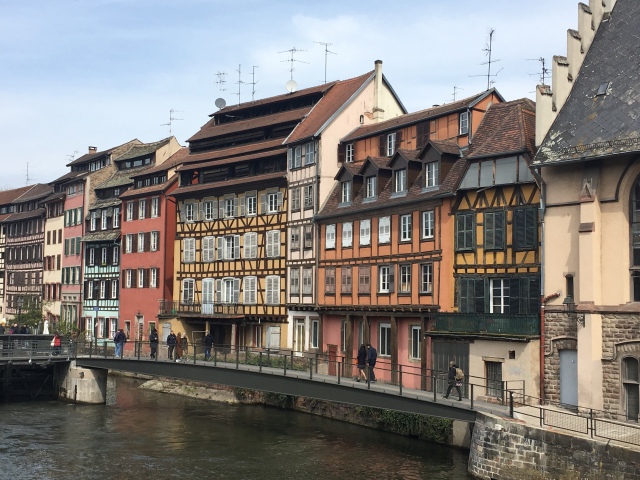
I once again took off on foot (I can’t say I did things the most efficiently) to the Petite France neighborhood of the city. Petite France is part of the historic region of Strasbourg, and has many of the architecturally iconic houses associated with Alsace, and the 12/13th centuries. You can also cross over the covered bridges, and envision what life used to be like for those living in Strasbourg centuries ago. It’s a fun little area to explore, especially when the weather is nice. Petite France is also home to the Barrage Vauban, a 17th century bridge, that also probably served as a defense system when it was built. You can climb to the top terrasse for a view of Petite France, and see it stretch into what is now modern Strasbourg.
View from the Barrage VaubanHouses in Petite France
After picking up some lunch to satisfy the energy depletion that came with all the walking, I decided to explore some of the many churches in the area. I started with the catholic Eglise St Pierre-Le-jeune, and followed it up with the Protestant Eglise St. Thomas. I ended my church expedition with the Cathedral of Strasbourg, which has a striking façade, and is immense. The inside was a little dark to me, but the outside is certainly something which should be admired. If you need to be convinced further, check out this photo and let it convince you:
I also sought out the synagogue, and I was not expecting it to be as big as it is. The outside is imposing in size, and it’s nice to know that Strasbourg is keeping in line with its religious roots. There is also the old Jewish quarter you can explore, which includes Rue des juifs, and although there’s little physical evidence of a presence left, it still did exist.
To round out my Saturday, I had a bretzel (yes, you’ve read that correctly, BBBBBBretzel. Who’s correct, you ask? If only I knew. It’s confused me and I would like to know so I can properly call them either a pretzel or bretzel).
As I happened to be in town on the first Sunday of the month, all the museums were free, so naturally I stockpiled the museums for my last day in the city. Coincidentally, it also wasn’t as nice of a day on Sunday, so it worked out for the best that I had planned to be inside most of the day.
I started out my morning at the Musée Alsacien, a museum of Alsatian history. It’s housed in an older style Alsatian house, and offers traditional costumes, furniture, housing layouts, and other various items from different eras of Strasbourg’s history. In doing so, it acknowledges the rich cultural, and religious history that exists within the region, and the way in which it has almost separated itself from the rest of France in that way (it’s still French, believe me, but you can see the outside influence, and the way it operates just a smidge differently). I really enjoyed the museum and all the artifacts, as well as its creative layout in using an actual house as the museum!
Right on the other side of the river (as in, right over a bridge), is the Musée Historique de Strasbourg: the history museum. Again, this is a super well done museum that offers a vast amount of history (sometimes even bordering on too much information) about Strasbourg from the Roman days, all the way to its place now as the European capital. It’s very informative, and I loved wandering through the ages, while discovering artifacts, clothing, and the history of the region, which is extremely vast. I imagine you could easily spend an hour or more here!
My last museum of the day was the Palais Rohan, which is a literal palace that houses three museums. Unfortunately, only two were open today (the archaeological museum being closed), but that was a decent amount to explore. I didn’t find this particular museum as interesting as the other two, but it was still a good visit. On the ground floor, there is a decorative arts museum, which focuses mainly on interior design. As you can imagine, it being a palace, there are plenty of ornate items of furniture and tapestry (when you see all the opulence, you can understand why the French revolted against the monarchy). There are also China plates, and a random room filled with different clocks. Upstairs, there’s the fine arts museum, which houses European paintings from various centuries. It’s a nice walk through, but not being an art aficionado myself, I don’t need sprawling rooms of paintings to get my art fix.
I feel like I definitely got the most out of my weekend in Strasbourg, and that I can honestly say I’ve seen what I wanted to see! I’m glad I decided to come out here as part of my mini Tour de France, and after starting out so strong, I’m even more ready for the next cities. Next stop: Lyon!
When I was in England, I wrote a blog post about Britishisms and things I’d noticed that were kind of specific to British culture. Now that I’m over in France, I thought I would do the same thing! Again, don’t get me wrong, I don’t think negatively about the French culture at all (or at least, not about everything), but I do find it fascinating to examine differences in culture, and in day-to-day life. Enjoy!
Long(er) meals
At the schools where I work, the students (and myself) get an hour and a half for lunch. This includes recess and time for eating for the kids, but in the US, it seems like you’re lucky if you get half an hour to eat. Although this means that the lunch hour can sometimes drag on if you have no one to talk to or nowhere else to go, it means that you have time to decompress and prepare yourself for the afternoon. Not to mention the fact that you don’t feel rushed to inhale your food (so I could actually prepare decent lunches for myself instead of just a small sandwich because that’s all I could eat in the time I had – although that it what I eat because who can resist a good lunch time sandwich?). The students also get much more balanced, and healthier lunches in the cafeteria, and the menus sometimes include things you’d never see in a US elementary school (one prime example would be rabbit for lunch). The best thing is that it’s not just lunches. If you go out to dinner, you’re not rushed to pay your bill after they clear your place. You can chat, hang out, and be relaxed until you’re ready to pay and leave. The French take eating very seriously.
Chip flavors
Okay, I’m not sure if this is a super “frenchism” but I got a kick out of it anyway so, I’m using it. Literally my first day in Angers, my mom and I went to Monoprix to suss out the goods, and to see what I would have access to grocery wise. We wandered around this fairly big store and somehow ended up in the chip aisle. After glancing haphazardly through the titles, my eyes fell upon a bag with a cheeseburger flavor. That was quite the double-take. From there, there was roasted chicken, pickles and mustard, and my all time favorite: ham and cranberry. I’m not sure if this is a national thing, but those are pretty daring flavors. Here I was thinking prawn cocktail in England was adventurous!
Timeliness (and its almost non-existence)
Within my time here, it has come to my attention that if you want anything done, you should’ve asked for it a week before you needed it done. Part of this is the bureaucracy, but part of it is also just a “we’ll get to it when we get to it” kind of attitude, which is nice sometimes, but not so nice when your toilet is running and you’re told it could be a week before someone looks at it (I realize this could be universal, but it’s the manner in which you’re told you’ll have to wait that really adds the oomph to this frenchism). Not to mention, you seem to need appointments for everything (for instance, for opening a bank account) and heaven forbid you be able to do something the day you planned on getting it done! One might even say they have a bit of a laissez-faire attitude towards life, and you can definitely see where that saying originated.
Stores aren’t open all the time
One of the first days I was here, my mother and I made the mistake of waiting until 3pm to try and find lunch. Much to our surprise, almost every place was closed. Many eateries close at 2pm, and don’t reopen until dinner time, around 7pm. Because of this, most places (including banks and other offices) close from 12 until 1:30/2pm to make sure that everyone can get food if they want. As aforementioned, the French take their lunch break seriously. Additionally, very little is open on Sundays. That means your options are limited for eating out, the grocery stores close earlier (if they’re even open at all), and the streets are pretty empty throughout the day. It’s fine to navigate if you’re aware of the closures, but not great if they catch you off guard. This also means that the places that ARE open on Sundays are often packed, and have long lines because of this. It can also make Sundays quite dull since there isn’t much to do. Banks are also always closed on Sunday, and many aren’t open on Monday so you better hope you don’t have any banking emergencies over the weekend (honestly not that big of a deal unless you want to do something with a person because ATMs are open 24/7). Peep this funny comic another assistant shared on Facebook to illustrate the struggle:
BREAD
I’m pretty sure the French eat bread, usually baguettes, with every meal. It’s a solid staple and I appreciate a culture that doesn’t shy away from its carbs. One fairly true stereotype of the French is the number of people who do, in fact, walk around carrying a baguette from the shops. It makes you feel slightly more French when you walk around wielding a massive loaf of bread in your arms.
Vous vs. Tu
In French, you address people differently based on their age, status, or position relative to you (formality is taken very seriously in this language). Anyone older than you, or superior to you is addressed using a “vous,” while your friends and those younger can be called “tu.” They have aptly named this se vouvoyer and se tutoyer. It’s always a question when meeting a new person whether it’s a vous or a tu situation, so to be safe, always go with the vous. Half of the teachers with whom I work have been super chill about us tutoying each other, but the others haven’t said a word, and I’m not about to rock the boat that is French grammar. Ironically, you get in trouble for not vousvoying when you should, but the teachers have also corrected me when I accidentally use vous instead of tu with them as well!
Never-ending paperwork
One thing I didn’t necessarily expect was how bureaucratic France is, and the sheer volume of copies and signatures they require for even the tiniest little thing. It feels like for any little thing, you’re going to need your birth certificate, bank information, photocopy of your passport, and your work contract, along with potentially random other tidbits. On top of that, once you’ve submitted any given application, you’ll then have to wait for approval, you’ll get a letter telling you you’ve been approved, then another letter with whatever it is you originally wanted, and then another letter outlining the details of what you’ve received. I had to sign three copies of my work contract, and when setting up a bank account, had to initial all 10ish pages of the document outlining everything. I think there are a lot of trees dying due to France’s penchant love for requiring literal mounds of paperwork for everything. Not to mention, you’re told to keep your pay stubs for the rest of your life, so honestly, I can see how it’s a bit of a thing here. To further back up the length of time things take, I received my November paystub in MARCH… you can imagine the strength of my eye roll when I opened that envelope.
Striking
Faire la grève could potentially be considered a national pastime. The French are very proud of their allotted hours for the work week, how many vacation days they get, their right to public transportation, and many other things, to the point that when one of those rights is infringed upon in the slightest fashion, the unions might announce a strike. Since moving here, there has already been a national strike (which didn’t impact me specifically but some teachers at other schools went on strike, and transportation was a little delayed), two strikes where my school(s) for the day was closed the entire day, and some smaller strikes on the bus services, which can lead to minor delays or no busses running on certain lines, and various other “social moments” that occur. (Don’t get me started on the gilets jaunes, because that’s just a whole other can of beans)
Tea with no milk
At my orientation for work, the woman in charge told us we were going to break for tea and coffee. I saw a box of English Breakfast tea, and promptly got very excited as for various reasons, I hadn’t had any tea since I arrived in France. I poured myself a nice cup (in a plastic cup), and looked around for the milk. We all searched around the room, in the fridge, and asked about it, only to be told that the French don’t take their tea with milk (cue the gasps). I thought this was just an isolated incident, but alas, I’ve seen it many more times in my schools, on essentially a daily basis! How the French can make such beautiful coffee and wine, and yet still drink tea without milk is completely beyond me.
Split classrooms
This is specific to the French education system but it isn’t a rare occurrence to have at least one (if not more) classroom that is made up of multiple grades in a school. The smaller of my two schools only has three classrooms and all three of them are split grades. The theory behind this practice is that it allows students to learn empathy and how to work with students either ahead or behind them, while also potentially pushing them to learn a little more than they would if they weren’t in a split class. Sometimes this is done, however because of size, resources, and the number of teachers available at any given school.
Scarves
I swear, in France, a scarf is the most important, and necessary accessory for any given day, regardless of the weather. In my first month in Angers, there were several low-to-high 70s days, and you’d walk around seeing people wearing heavy coats and bundled up in scarves! It’s like the scarf simultaneously keeps them warm AND keeps them from getting too hot! They also have this way of tying their scarves that I feel like unless you’re French, you can’t replicate, and I would like to be let in on that secret, please.
Non-refrigerated milk
You can still find milk in the refrigerated section, but if you go to larger supermarkets, there’s also milk you can buy on the shelves. You refrigerate it after opening, but seeing milk sitting on a shelf at room temperature threw me for a loop the first time I saw it. Plus, it expires much more quickly it seems than the ones that come straight out of the refrigerator. (Related side note: some of the yogurts have fromage blanc, i.e. white cheese written on their labels, but I have been assured that the yogurt does not, in fact, contain any cheese.)
AZERTY keyboards
It’s a minor thing, but typing with a keyboard that uses the same letters as English, but puts them in a different order is beyond confusing to my touch typing brain. Not to mention, French has accents, so those characters live with the numbers at the top of the keyboard EXCEPT they have priority over the numbers so you have to press the ALT key plus the number key in order to get the number. Don’t even get me started on punctuation as well because some keys have THREE characters so there are three different ways to achieve three different characters and honestly sometimes, I just spell the words wrong and hope for autocorrect. Sometimes I’ll even start typing incorrectly on my laptop after a day of having used a French computer… Just take a look if you don’t believe me:
MORE PAPERWORK
Did I mention the paperwork issue already? I did? Funny, because that’s exactly what the bureaucratic situation is like in France because you think you’ve done something already and know all about it, and then NOPE, you’ve got to do it all over again but this time with different information… plus signing it, submitting it by mail, along with a pdf copy submitted online, and just for kicks, you’ll have to email it along with an additional copy because vive la France. I’m already dreading leaving if only because I have to write a properly worded letter to cancel my phone plan, close my bank account, cancel my housing assistance, and terminate my rent agreement… because we love killing trees here, and making things more difficult than they need to be!
Bonjour
Even though saying hello to each other isn’t something that is specific to France, it seems like the French take a certain type of pride in uttering bonjour to their colleagues and friends (and depending on where in the region/country you are, this can be applied to crossing a random human on a walk in the park, or on the street). All the teachers with whom I work make a point of saying bonjour to me when they first see me, and I’ve frequently heard teachers say to other teachers “I haven’t said hello to you today yet, have I” as if it were sacrilege to have not greeted your coworkers in the morning. Not only this, but if they happen to have said hello to each other already, they will proceed to say rebonjour… the French have a word specifically for saying hello to one another again, and I quite enjoy the novelty of it. Not to mention, they take saying hello so seriously, that it’s essentially a routine that every interaction must begin with bonjour regardless of where, when, and with whom, and they take offense if you skip that little introduction in your interaction. I’ve frequently asked people in shops, or at the train station for assistance, and gotten their attention by saying “excuse me” and proceeding to ask my question, only to get a look of disdain in return as they aggressively look at me in order to say bonjour, to make the point that I forgot that pivotal word. (I once overheard a customer at a smaller supermarket get mad at the person behind the cash register once because he “walked in and nobody said hello” to him after he had said the requisite bonjour, so it’s a thing with strangers as well).
Nonexistent public restrooms
This seems to be a European thing in general, but France really doesn’t buy into having restrooms accessible to the general public (and if they do, they probably won’t be free). Going out, or traveling somewhere can become an endeavor of planning, and you always have to be prepared to potentially have to shell out some coins for the privilege to pee (Shout out to you if you understand the Urinetown reference there…)
La Bise
When you greet someone in a friendly setting, this can sometimes prompt the act of la bise, where you greet the other person with a kiss (it’s really a cheek-to-cheek sort of action) on each cheek (which one starts still baffles me). It’s not something that I’ve had to do frequently, but I’ve definitely had the awkward start with some people of the whole “should I, or shouldn’t I” type thing when it comes to the whole ordeal. It can certainly be disconcerting if you’re not expecting it, and perhaps a little awkward at first, but it’s definitely part of the custom. I’ve seen teenagers partake in it while greeting each other on the bus in the morning, so a sure fire way to pretend you’re wholly French, is to use la bise as a greeting (when it’s appropriate, of course)!
Lack of self checkouts
This is kind of an odd one, but in most of the supermarkets where I shop, there isn’t an option for self-checkout, meaning you have to wait in a line with everyone else (there are never enough lines), and then check out that way. This always massively stresses me out because there aren’t people helping bag the groceries (which isn’t odd within itself, necessarily), so you have to frantically bag as the cashier scans the items, but sometimes it isn’t in the right order so you end up shoving things into your bag so rapidly so that you can get out of there before the next person starts coming through. The one store where there is a quasi self check-out option calls itself “express” so I always get people giving me a slight side-eye as I rock up with my rolling basket, even though I’m quick, and I’m not actually buying that many things. I miss having the “15 items or fewer” aisles, as well as the plentiful number of checkout lanes during peak business hours.




 Not Your Average Giraffe